The high life: how to do Mount Everest without being a pro
It has never been easier – or more luxurious – to visit the countryside around the mountain

Mount Everest is irresistible, yet dangerous. Most will not stand on its summit. Happily, visiting the foot of the mountain has never been simpler, with treks and tours in the surrounding Nepalese countryside revealing a stark landscape that is even dotted with a few luxury resorts, complete with champagne to go with the views.
I came to the Khumbu, as the region of Nepal around Everest is called, in late October, the heart of the trekking season. Together with 10 others, I was booked on a trek with World Expeditions. Part of the trek included a visit to Everest Base Camp, the closest an average tourist can come to Everest itself. Known as EBC for short, it is the starting point for attempts on the southern (Nepal) side of the mountain. There are also two base camps on the northern (China) side – one off-limits to tourists, who are driven to a spot not far away called a “base camp” for the purposes of tourism. There you can send a postcard and even stay for the night. The view is stunning but tranquil it is not. There is much more satisfaction in an approach up through the Khumbu, following at least part of the route taken by the 1953 British Expedition that succeeded in putting Sherpa Tenzing Norgay and Sir Edmund Hillary on top of the mountain for the first time. Precisely how you follow this route depends on your commitment, time and budget.
The most faithful trekkers walk. You can start in exactly the spot that Hillary and Tenzing started but most visitors save themselves a few days and fly, as we did, into Tenzing-Hillary Airport in the small town of Lukla, at an elevation of 2,860 metres. The airport itself is a highlight, and after we had landed to spontaneous whoops and clapping, we watched other aircraft struggle upwards into the thin air off an inclined runway that looks ready to slip right off the hillside itself. From there, it was three-day walk at a gentle pace up to Namche Bazaar, the largest settlement in all Khumbu, around 600 metres above Lukla. The pace was intentionally slow, which helped our bodies adapt to the high altitudes. I had walked up this stretch in less time on a previous visit, but our guides were right – I suffered no repeat of my altitude headache on arrival.
Namche Bazaar, with just more than 1,000 residents, counts as Big City in the Khumbu. Once a trading post between herders on the mountains and farmers from the valley bottoms, it is now essentially a large outfitting post for trekkers, with fleeces and puffy jackets, real and fake, on every corner. Family-run stores sell cheap thangka paintings next to western chocolate next to crampons. You can brush up on your mountain lore at the local Irish pub, which claims the title of “highest Irish bar in the world”.
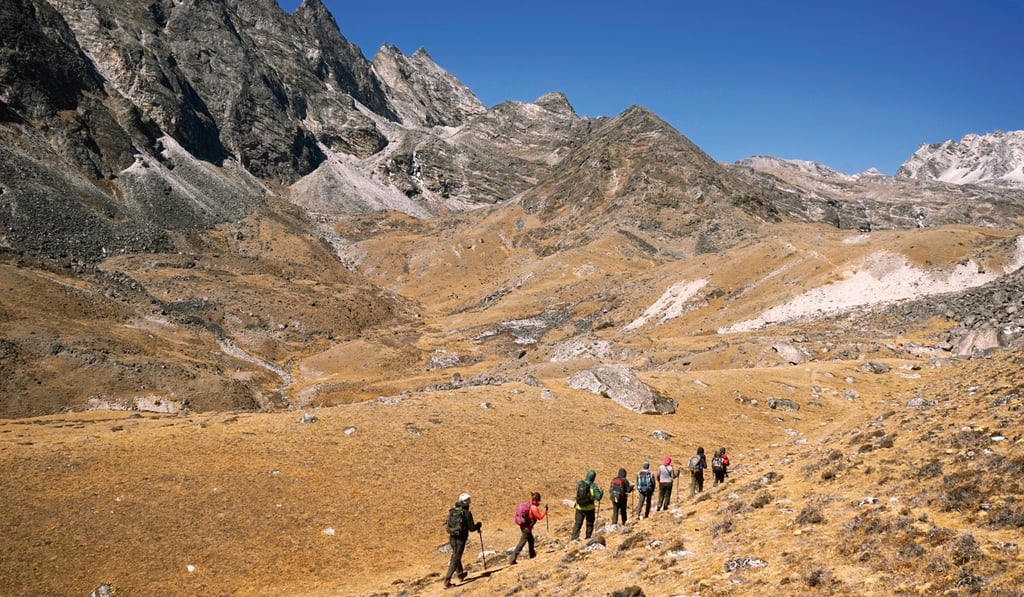
In Namche, we had our first acclimatisation day, making our way up to the school and hospital built by Sir Edmund. We also got our first look at the mountain at the end of the valley. Still many kilometres away, Everest’s squat rocky pyramid was visible, although overshadowed by the photogenic Ama Dablam (6,812 metres), which rises dramatically above the valleys and is fluted with ice and snow. An incredible view of Everest may be your aim, but it is a sure thing that Ama Dablam will hog many of the shots of your trip. Walking up to and past it over a number of days, it changed form but remained irresistible. While Everest’s dark triangle grew almost imperceptibly on the horizon, our eyes constantly swivelled right to the snow-draped “mother” and “child” peaks of Ama Dablam.