Advertisement
South China Sea: Analysis
Opinion

Is the US gearing up for a direct challenge to Beijing’s sovereignty claims in the South China Sea?

Mark Valencia says a follow-up freedom of navigation operation by the US Navy may well happen soon, but Washington must take into account the legal and political implications, as well as Beijing’s reaction to any ‘provocation’

Reading Time:4 minutes
Why you can trust SCMP
A photo taken from a military plane shows China's alleged ongoing reclamation at Mischief Reef in the Spratly Islands. Beijing’s campaign of island building in the South China Sea might soon quadruple the number of airstrips available to the PLA in the highly contested region. Photo: AP
Mark J. Valencia

Last October 27, the destroyer USS Lassen carried out a “freedom of navigation operation” in the South China Sea. It was rather a long time in coming, as the wisdom of doing so was hotly debated between the US Defence Department and the White House national security team.

It was purportedly intended to challenge China’s maritime claims there. But its execution was muddled and the message ambiguous. There is mounting domestic pressure in the US to follow it up with a clear challenge to China’s claims. But there is also mounting domestic pressure in China to respond to any further US “provocations”. So what is likely to happen next and what are the legal and political considerations?
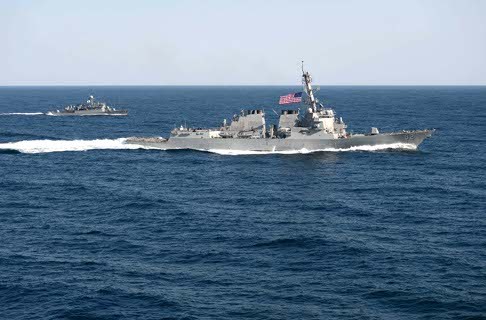
The guided-missile destroyer USS Lassen. The United States defied China in 2015 by sending the warship close to artificial islands Beijing is building in disputed waters. Photo: AFP
Shortly after the USS Lassen steamed within 12 nautical miles of the China-claimed and occupied Subi Reef, analysts were predicting a quick follow-up in the vicinity of China-claimed and occupied Mischief Reef. But that has not happened. It may – and soon, but the delay is not a surprise. The decision is complicated.
Advertisement

Nearly two months passed after the Lassen incident before US defence secretary Ashton Carter responded to a letter from Senator John McCain, chairman of the US Senate Armed Services Committee. Carter’s reply was incomplete – it did not answer McCain’s first question: “Under the freedom of navigation programme, what excessive claims was the Lassen operation intended to challenge?”

A protester holding a sign that reads “Strongly protest against US encroachment on South China Sea. Attack USS Lassen. Americans get off South China Sea” is confronted by two Chinese police officers outside the US Embassy in Beijing. Photo: EPA
Carter stated that the operation was conducted in accordance with “innocent passage” because the Lassen entered what “may be claimed as a territorial sea”. It was also executed without “prior notification”. Subi Reef was submerged at high tide before China’s reclamation work and thus, according to the UN Convention on the Law of the Sea, it is not entitled to a territorial sea, only a 500-metre “safety zone”.
Neither China nor Vietnam have specified their claims or baselines for territorial seas in the Spratlys

But the US defence department reckoned that Sand Cay – which is occupied by Vietnam but claimed by China (and the Philippines) – may be entitled to a 12-nautical-mile territorial sea, and the sovereign over Sand Cay could use Subi Reef as a base point, because Subi is within 12 nautical miles of the cay. So the freedom of navigation operation could be interpreted as primarily directed at Vietnam. Vietnam requires prior notification for foreign warships to enter its territorial sea. Further complicating the issue, neither China nor Vietnam have specified their claims or baselines for territorial seas in the Spratlys.

Advertisement
Advertisement
Select Voice
Choose your listening speed
Get through articles 2x faster
1.25x
250 WPM
Slow
Average
Fast
1.25x