Economics can be a powerful alternative to sanctions and military options.
Despite sanctions and warnings, Pyongyang recently tested an alleged hydrogen bomb and launched a satellite rocket with a payload twice as heavy as its previous successful launch in 2012.
North Korea is the only country known to have conducted nuclear tests this century and this was its fourth since 2006, which points to an unwavering ambition to achieve long-range ballistic nuclear deterrence. The response so far is for more sanctions: the blunt tool that hasn’t proved to work.
North Korean leader Kim Jong-un gives a speech at a party in Pyongyang for scientists who contributed to the launch of the Kwangmyong earth observation satellite. Kim has promised to put more satellites in space, even as the international community prepares to punish his regime over a long-range rocket launch. Photo: AFP
China is in a quandary. It delivers 80 per cent of North Korea’s trade, 70 per cent of its energy and half of its food supplies. While accepting the need to deter Pyongyang, Beijing remains firmly opposed to oppressive sanctions that would precipitate a humanitarian disaster on its doorstep. Over the years, 30,000-60,000 North Korean refugees are said to have escaped to China. Some believe the total could be more than 200,000. The majority first make their way to China before moving to other parts of Asia, including South Korea. The current European refugee crisis only serves to strengthen China’s resolve.
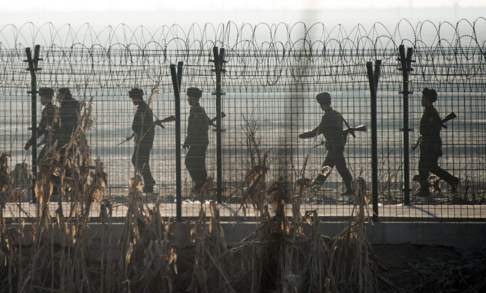
North Korean soldiers patrol the border fence near the town of Sinuiju, across from the Chinese town of Dandong. Photo: AFP
“Sanctions are not an end in themselves,” said Foreign Minister Wang Yi (王毅), who advocates bringing North Korea back to the negotiating table. However, since 2003, successive six-party talks have yielded few results. A hurried visit by Beijing’s envoy, Wu Dawei (吳大偉), to North Korea days before the rocket launch turned out to be an embarrassment.
China regards stability on the Korean peninsula as an overriding interest
China regards stability on the Korean peninsula as an overriding interest. A friendly nation on the peninsula provides a buffer between China and the democratic South, home to around 29,000 US troops.
Advertisement
The US and its allies are showing growing impatience with China’s response. Notwithstanding recent warmth towards China as its largest and most promising trading partner, South Korea’s President Park Geun-hye said she would consider deployment of US Thaad (terminal high-altitude area defence) missiles on South Korean soil, despite strong Chinese opposition.
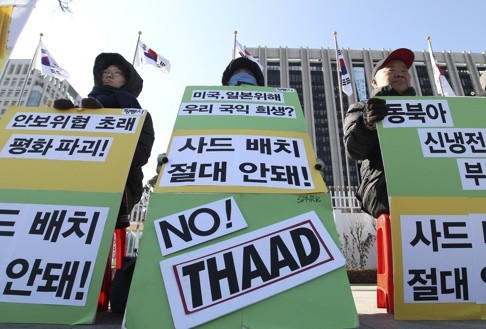
South Korean protesters stage a rally in Seoul to oppose the possible deployment of the US’ advanced missile system on the Korean peninsula. Photo: AP
If China appears to be caught between a rock and a hard place, the US and its allies do not seem to be much better off. There is no guarantee that even with China’s (and Russia’s) support at the UN Security Council, tougher sanctions would work this time. Rhetoric notwithstanding, Thaad deployment is likely to ignite Pyongyang’s dangerous firework antics. If anything, it would only hasten North Korea’s nuclear and missile programmes. A US/South Korean pre-emptive military option would be out of the question. There is no public appetite in the US for another Korean war, save in extremis. For South Koreans, attacking the North unprovoked would risk nuclear suicide.
Pyongyang’s greatest fear is perceived to be US-led regime change
Pyongyang’s greatest fear is perceived to be US-led regime change. Long-range nuclear missile deterrence is seen as the only effective insurance policy. Resistance to foreign coercion serves to prop up regime legitimacy in the knowledge that China would not allow its regime to collapse.