Everyone should be equal under China’s university entrance exam
Winston Mok says China needs to make the quota system for its gaokao fairer, so it doesn’t favour students from the top cities, to ensure education remains a sharp tool for upward mobility

I was somewhat surprised that The Hunger Games movies were ever released uncensored in China; they are uncanny reflections of Chinese society. Today in China, another round of “games” has just finished – the sitting of the annual university entrance examination. But, unlike in the movies, no representatives can be deployed; most young people have to play.
In The Hunger Games, while representatives from districts one and two receive better training, the playing field is somewhat level. But for China’s university entrance exam, the odds are strongly in favour of districts one, two and three (Beijing, Shanghai and Tianjin). Their residents, besides getting a better high school education, have a much better chance of gaining admission to universities in their home cities, the best in the country.
Thousands of Chinese parents take to the streets to protest university admission quotas
Last month saw protests in Jiangsu ( 江蘇 ) and Hubei ( 湖北 ) – districts four and five, if you will – by disgruntled parents over new quotas which will mean better access to their universities for students from districts 11 and 12 (poorer inland provinces). Why should they make “sacrifices” when the top districts do not open their doors wider?
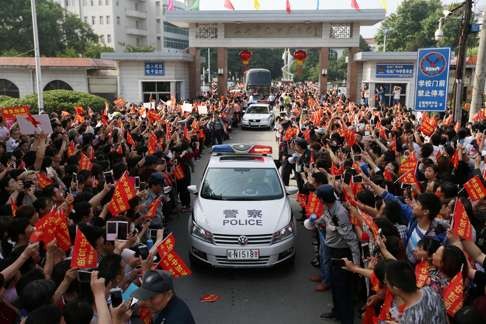
‘Be fearless, this is the start of your bright future’: Stephen Hawking to China’s 9 million students taking entrance exams
The obvious solution is to level the playing field, so that everyone competes equally for entrance to Peking or Tsinghua university, regardless of where they come from. University entrance exams need to be standardised nationally, for starters. However, such a “radical” policy faces opposition as policymakers live in Beijing. Why would they change a system that strongly favours their children or grandchildren?