The makings of a South China Sea agreement between Beijing and Manila
Mark Valencia says with both sides now displaying a willingness to engage, China and the Philippines have a chance to negotiate for mutual benefit

The lords of public international law have spoken. The July 12 award by the Permanent Court of Arbitration regarding the Philippine-China case upheld almost all of the Philippines’ complaints. The most significant aspects of the decision were the denial of China’s nine-dash-line claim to historic waters or rights within it and that none of the Spratly features are legal islands which can generate 200-nautical mile exclusive economic zones and continental shelves. That is what international law “says”. But acceptance and compliance are another matter.
Indeed, this is where international law and political reality diverge. The Philippines is hoping it can now go to the negotiating table with leverage gained from its legal victory. But China has declared that the decision is “null and void” and that it will not observe, implement, comply or even discuss it. So where can they go from here?
Common ground: Philippine President Rodrigo Duterte unites predecessors to discuss South China Sea dispute
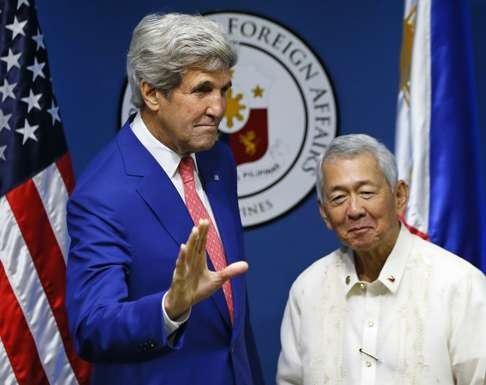
The dispute and its resolution will not only affect Philippine-China economic, political and security relations, but have implications for China’s relations with the whole region – and its political stability. Even the United States has called for both parties and the Association of Southeast Asian Nations to explore ways to ease tensions. Indeed, US Secretary of State John Kerry said that Chinese Foreign Minister Wang Yi (王毅) asked him to throw his support behind bilateral talks between Manila and Beijing. This is good news. Kerry visited the Philippines days later and stated: “We hope to see a process that will narrow the geographic scope of the maritime disputes; set standards for behaviour in contested areas; [and] lead to mutually acceptable solutions – perhaps even a series of confidence-building steps”.
To improve relations with its neighbours, China needs to get beyond the decision. As the dust settles, China can take some satisfaction that it has demonstrated its control of some Spratly features and is thereby in a stronger position to negotiate such sovereignty issues. Further, no official in rival claim countries, including the Philippines, has yet suggested that it remove its personnel from the low-tide elevations it “reclaimed”. Moreover, the decision included no “cease and desist” order.
Nevertheless, China has lost face and it and the Philippines are locked in a dilemma. China has declared repeatedly that “no discussion of the decision” is a precondition to any negotiations with the Philippines. For China’s leadership, this will be difficult to back away from because nationalists at home are already aroused. Indeed, given other domestic problems, Xi is already skating on thin political ice.
