A balancing act for Suu Kyi as ‘fraternal friendship’ with China echoes beyond borders
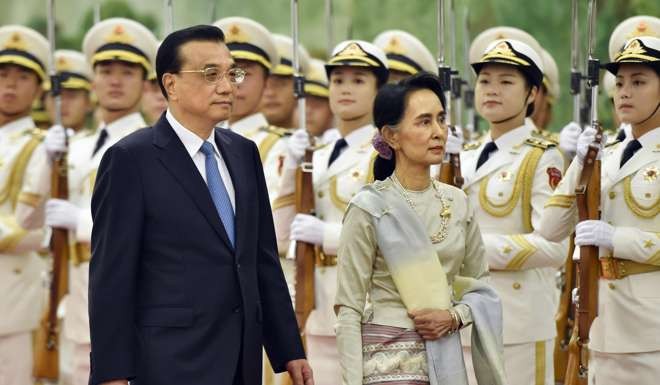
Cary Huang says the democracy advocate has made a statement by choosing Beijing for her first major foreign destination as de facto Myanmar leader, as she seeks to weigh idealist ideology and practical national interest

Theoretically, nothing is more divided than the ideology between pro-democracy campaigner Aung San Suu Kyi and China’s authoritarian government.
Thus, a democratic Myanmar may be naturally moving closer to the West and farther away from China’s communist regime, which put Suu Kyi’s fellow Nobel Peace Prize laureate Liu Xiaobo (劉曉波) in jail.
For a long time, Washington has isolated the military regime and supported pro-democracy forces led by Suu Kyi, while Beijing has steadfastly stood by Myanmar’s military junta and rejected any pro-democracy forces, fearful of a spillover of ideas across the border.
As Suu Kyi heads home, solving dam deadlock remains key to improving ties between China and Myanmar
However, national interest and pragmatism have always prevailed in diplomacy. And the world is now closely watching how Suu Kyi navigates great power politics and balances her idealist ideology with practical national interest.
Suu Kyi, human rights activist and opposition leader turned de facto state leader, is firstly tasked with the responsibility of governing a country. Many observers believe Myanmar’s China policy is at a critical juncture as the NLD government is faced with the challenge of striking a balance between two diverse policies. It could choose to cater to anti-China sentiment at home and implement a pro-West policy, at the risk of losing Beijing’s support for critical domestic economic development and the peace process. Or, it could try to build friendly relations with the communist giant, but at the risk of losing critical political support at home and in the free world.