
Hong Kong must wake up to the danger of Beijing’s meddling
Gary Cheung says the liaison office’s increasingly assertive role in local politics contravenes the central government’s promise of a high degree of autonomy for the SAR

When veteran diplomat Jiang Enzhu arrived in Hong Kong in 1997 to become the first director of the central government’s liaison office in the city, he tactfully brushed aside the barrage of questions by describing Hong Kong as an “abstruse book” from which he would strive to learn. During his five-year stint as Beijing’s de facto envoy to the city, Jiang kept his head down and seldom commented on Hong Kong’s internal affairs. Other senior officials from the liaison office were barely visible at public functions.
Beijing’s low profile at the time reflected the confidence the central government had in Hong Kong to run itself. To many, such invisibility is now a distant memory.
‘Bad boy’ of Hong Kong politics accuses liaison office of interference
Shocked by the 500,000-strong march against national security legislation in 2003, Beijing has since cast aside its hands-off approach. When Tung Chee-hwa introduced the ministerial system in 2002, the candidates he nominated did not need to have interviews with Beijing officials as the central government had full trust in Tung. But people in the know told me that the newcomers in Donald Tsang Yam-kuen’s team of ministers in 2007 had to go through interviews with the central government before they were appointed.
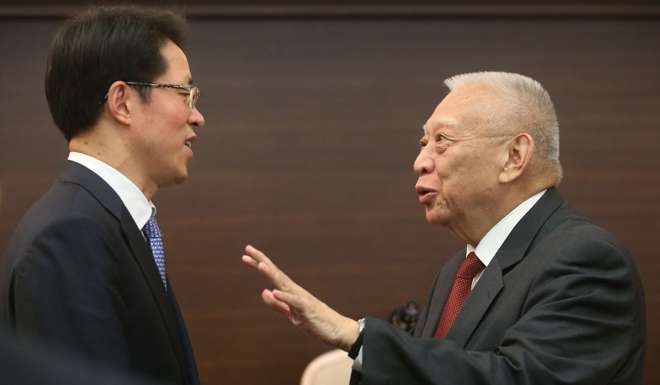
Don’t let Legco elections become stage for promoting independence, warns Beijing’s top man in Hong Kong
It is no secret that the liaison office has played an increasingly active role in coordinating candidates from the Beijing-friendly camp in the city’s elections since 2003. Ahead of the 2005 chief executive election, Chua Hoi-wai, a member of the social welfare subsector of the Election Committee which selected the city’s leader, told me that liaison office representatives took his fellow Election Committee members to lunch and asked them their views on the election, which he considered inappropriate.