Advertisement
US election: Trump v Clinton
Opinion

Triumphant Trump now needs a campaign to reassure nervous US allies in a world of risks

Andrew Hammond says that, with Donald Trump pulling off an upset victory, all eyes will be on how the US president-elect navigates geopolitical fault lines in terms of foreign and trade policies

Reading Time:4 minutes
Why you can trust SCMP
American supporters of Hillary Clinton take in the news of her defeat as they watch a live broadcast of the US presidential election at a restaurant in Yangon on November 9. Photo: AFP
Andrew Hammond
Donald Trump is now US president-elect in the most sensational political upset since at least 1948, when Harry Truman scored an unexpected victory. With many US allies nervous about what Trump’s win will mean for US foreign policy, he now has to begin a major campaign of reassurance and prepare for a host of major foreign policy challenges in a world full of potential danger.

Trump will start to receive enhanced intelligence briefings and his “in-tray” is vast. This will range from the Middle East – where big offensives are under way against so-called Islamic State in Mosul, Iraq, plus Raqqa, Syria – to the political tensions in South Korea, where the president faces pressure to resign at the same time that the nuclear stand-off on the peninsula has intensified with North Korea, and in Europe, where the migration crisis is adding to uncertainty over the future of the European Union, post-Brexit.
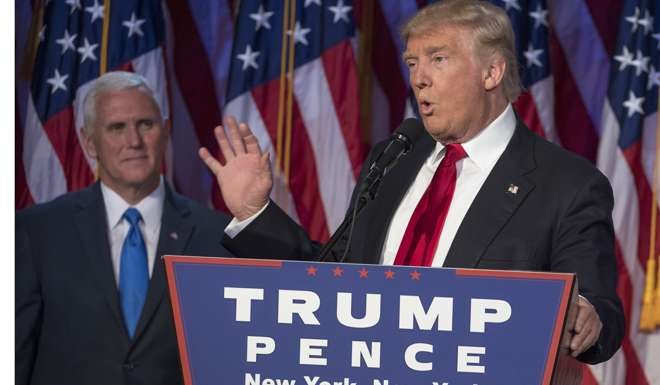
Donald Trump delivers his acceptance speech as running mate Mike Pence looks on, in New York City on November 9. Photo: TNS

World in shock as Trump clinches surprise election victory

One key area of uncertainty for allies is Trump’s trade policy and he must decide how hard to rhetorically “push back” if Barack Obama decides, before his presidency ends in January, to have a final push at getting congressional passage of the controversial Trans-Pacific Partnership. The TPP, which Trump strongly opposes and may now be “dead-on-arrival” in Congress, is a massive trade deal with 11 other countries in the Americas and Asia-Pacific (including Australia, Canada, Singapore, Japan, New Zealand, Malaysia, and Mexico), that account for about 40 per cent of world GDP.

Is Trans-Pacific Partnership trade deal really as dead as Trump and Clinton say it is?

This will be a big early call for Trump, given that many Republicans want the deal to embed US influence in the Asia-Pacific in the face of a “rising China”. If the TPP collapses, it will intensify doubts about US leadership in the region, potentially undermining Trump’s leverage with some local allies on other key issues.

Why does Singapore keep talking about TPP when everyone else has given up on it?

The conundrums now confronting Trump aren’t limited to these issues. Indeed, there are some indicators that international political risks are now at their highest level since the end of the cold war.

Advertisement
Other geopolitical fault lines include tensions with China over the latter’s territorial claims in the South China Sea, continuing instability in Afghanistan and Libya, and the bleak prospects facing the Israeli-Palestinian peace process. Meanwhile, continuing hostilities in Ukraine mean that Washington’s relations with Moscow are perhaps more strained than any point since the collapse of the Soviet Union.

What’s the world to make of Donald Trump’s foreign policy advisers?
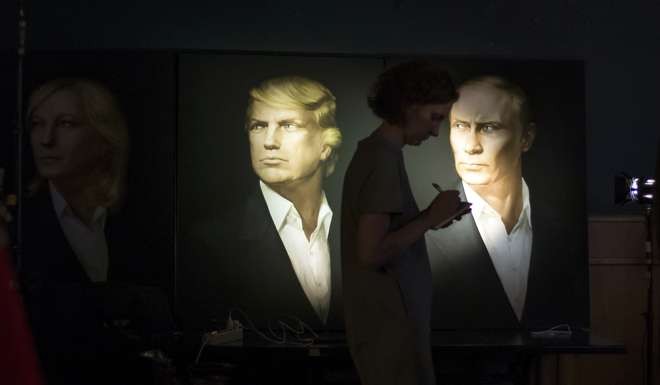
A journalist takes notes as she watches a live telecast of the US presidential election against the backdrop of portraits of Donald Trump and Russian President Vladimir Putin, at the Union Jack pub in Moscow on November 9. Russia's lower house of parliament has applauded Trump’s victory. Photo: AP
Advertisement
The bilateral relationship with Moscow under Trump will be a special source of scrutiny for many internationally. His relationship with Putin has been warm, rhetorically, and Trump has been criticised for calling Nato “obsolete”.
Advertisement
Select Voice
Choose your listening speed
Get through articles 2x faster
1.25x
250 WPM
Slow
Average
Fast
1.25x