Underwater drone spat shows why China-US relations are tense – and can only get worse under Trump
Tom Plate says the latest Sino-US tensions show both sides need to make a lot more adjustments to get along. For China, it means accepting a US leader who will certainly offend its sensibilities
The brittle personality and questionable global views of Trump are well suited to further roil the waters of the China-US relationship. Illustration: Craig Stephens
And so the question is sure to arise: Who will be blamed for “losing” the South China Sea to China? That utterly passive/non-aggressive Obama crew? Or, instead, will the sea change be viewed in a more sophisticated way – perhaps as a simple matter of a newly energetic China in full neighbourhood swagger?
The question resurfaceswhen the crew of a Chinese warshipscooped up a US oceanographic sea survey drone and absconded, apparently without a care in the world – and with a fishy finger in the US Navy’s face. Washington lodged a protest, of course – blah, blah, blah; and then the Chinese responded by saying the act was “professional and responsible” – blah, blah, blah.
In fact, according to a Hague tribunal recently, by the tepid authority of international law, central seas are everyone’s waters; but China has dropped enough hard infrastructure onto various islands and sandy shoals that we might as well face facts and accept the notion of uti possidetis juris (as you possess under law; or, in other words, possession is nine-tenths of the law). As an honest analyst at the Centre for Strategic and International Studies in Washington put it: “China has radically changed the balance in the South China Sea and no one can do anything about it.”
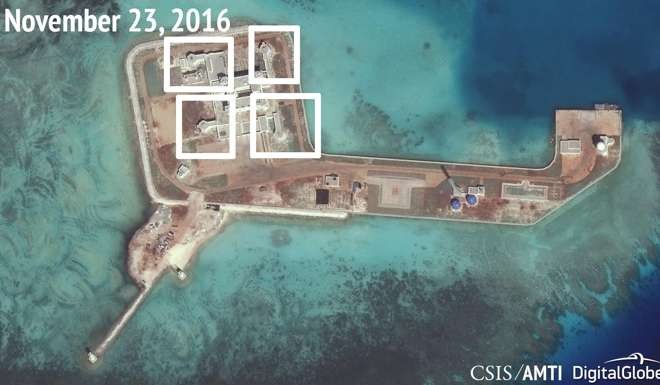
A satellite image shows what a think thank says appears to be anti-aircraft guns and what are likely to be close-in weapons systems built by China on the artificial island Hughes Reef in the South China Sea, in this image released this month. Photo: Reuters
The US Pacific Command, mustering pushback, has been rhetorically flapping its sails, more for the calming of allies than anything else: “You can count on America now and into the future,” declaimed Admiral Harry B. Harris Jnr in Australia. “Reports of America’s abandonment of the Indo-Asia Pacific have been greatly exaggerated,” he added. In reality, the rarely speechless US Pacific Command boss is caught between a rocky shoal and a sandy soft place. In his remarks at the Lowy Institute in Sydney, the ranking admiral depicted the People’s Republic of China as being “increasingly assertive”. He is surely right about that, but nations fighting to regain their balance after being knocked off stride for ages do tend to come off as pushy in rebound.
As far as anyone can tell, Trump’s beliefs are that the world needs to remain America’s oyster
Rather than throw curses at historical probability – whether via bombast or bombs – a responsible and visionary US foreign policy would focus more on the reality of the 21st century and China’s rising role in it.
Advertisement
One trick is to comprehend this giant on its own terms, rather than on ours, while still honouring worthy treaties with Japan and Korea (Beijing must try to swallow this). That won’t be an easy balance to maintain, but it will be easier and more prudent than if the US Pacific Command tries to regard the South China Sea with the same proprietary air as the US Fourth Fleet over the Caribbean.
Similarly, Taiwan is no run-of-the-mill issue but core to China’s sense of self, as President Barack Obama aptly acknowledged last week: “The idea of One China is at the heart of their conception of a nation.” This, after all, is the “Mainland Consensus”, and sometimes even the “Washington Consensus”: In remarkable respects, US diplomacy has handled the Taiwan issue with more delicacy than the South China Sea. Nuanced policy has helped foster functional autonomy for Taiwan, substantial economic growth on both sides of the Taiwan Strait, and peace in East Asia. That kind of result surely rates more than a passing grade in any professor’s class.