Shinzo Abe, friend of Trump and lacking Asian allies, is a true son of modern Japan
Jean-Pierre Lehmann says the prime minister’s cosying up to the US is consistent with the ideological arc of modern Japan, which more than a century ago decided to cast its lot with the West, turning its back on Asia
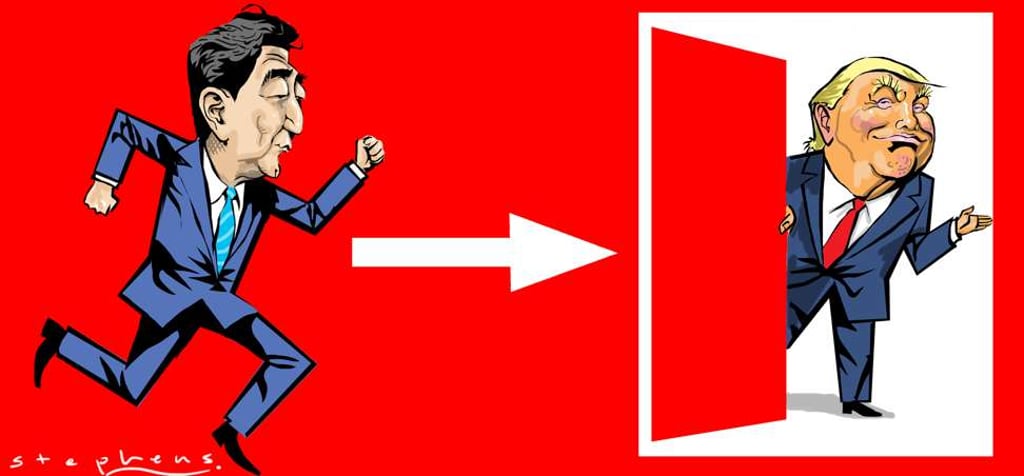
Whether the consolidation of the US-Japan security treaty (if indeed this is to happen) will strengthen peace in the Asia-Pacific region remains to be seen. We live in very dangerous times. Illustration: Craig Stephens
“Datsu-A, Nyu-O” was the title of a Japanese publication that first appeared in 1885, 17 years after the start of the so-called Meiji Restoration (1868), a period marking Japan’s amazing drive to modernisation. Not until perhaps the reforms launched by Deng Xiaoping (鄧小平) in China, in 1979, had the world seen anything comparable. From backward feudal isolation, in the space of a few short decades, Japan emerged as a modern, industrialised, imperialist world power. It was the only non-Western nation that succeeded in meeting the West on Western terms.
The document that set out the vision of this new Japan was titled “The Charter Oath of Five Articles”, the fourth and fifth of which read: “Evil customs of the past shall be discontinued, and new customs shall be based on the just laws of nature”; “Knowledge shall be sought throughout the world in order to promote the welfare of the empire.” The knowledge being sought was in fact from the West. The Datsu-A, Nyu-O publication – which literally means, “Exit Asia, Enter the West” – confirmed that promoting the welfare of the empire required “de-Asianisation” and “Westernisation”.
The rest, as the saying goes, is history. Japan learned and assimilated a lot from the West, primarily Britain, Germany, France and the US: constitutional law, jurisprudence, banking and finance, education, capitalism, modern military and naval strategy, railway building, industry, music, painting, sports (baseball from the US in 1873), lighthouses, textile manufacturing, watch making ... the list runs on. Until the undertaking of these reforms, ever since the fifth century, Japan had been a student of China and, to a lesser extent, Korea. Thus, “evil customs of the past” referred to Chinese learning.
Advertisement
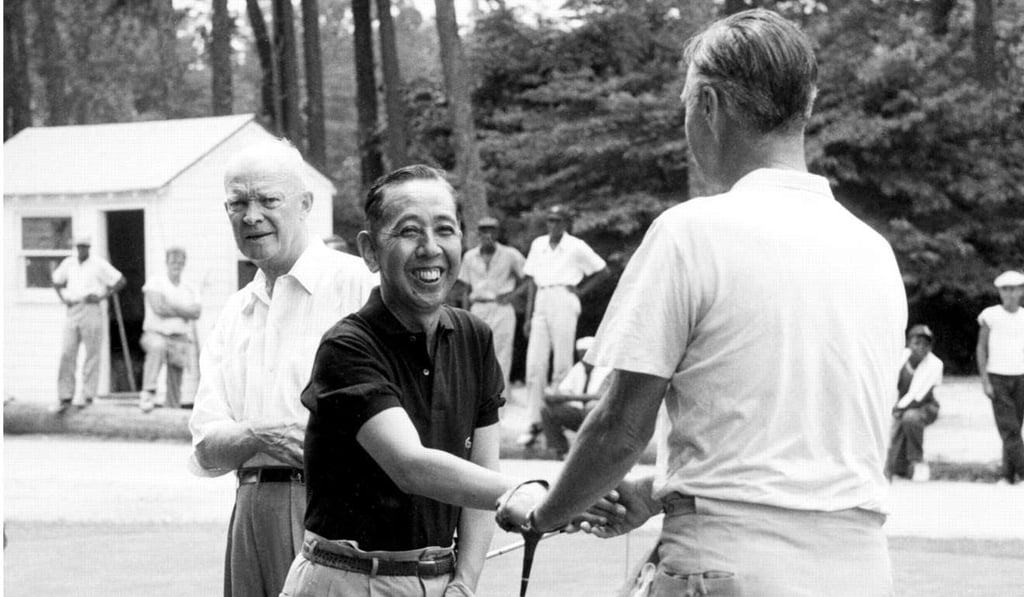
Reflecting this vision and trend, in the course of modern history, Japan has formed three major alliances with Western powers: Britain, from 1902 to 1922; Nazi Germany, from 1938 to 1945; and the US since 1953. While Japan had a number of Asian colonies (Korea, Taiwan and Manchuria) and invaded most countries in East Asia, it has never had, does not have, and, based on the current schmoozing between Donald Trump and Shinzo Abe, is unlikely to have any Asian allies. While playing golf with Trump in Florida, Abe pointed out that his grandfather, Nobusuke Kishi, prime minister of Japan from 1957 to 1960, was the last Japanese prime minister to have played golf with an American president (Dwight Eisenhower).
A post shared by Donald J. Trump (@realdonaldtrump) on Feb 11, 2017 at 10:27am PST
In this June 1957 photo, then Japanese prime minister Nobusuke Kishi shakes hands with then senator Prescott S. Bush, watched by then US president Dwight Eisenhower. Photo: AP
Kishi in many ways embodied the Datsu-A, Nyu-O syndrome. During the war as the senior official in charge of the industrial policy of Manchukuo, he was responsible for the abduction of hundreds of thousands of Chinese slave labour, for which he earned the sobriquet Showa no yokai – “Showa-era monster”. For his war crimes, Kishi spent three years in Sugamo prison, but was released by the US as the Chinese liberation, the Korean war and the cold war changed the picture of the Asia-Pacific theatre. He was judged a good candidate to help lead Japan in a pro-US direction.