Advertisement
Kim Jong-nam
Opinion

China turns the screw on North Korea with its coal ban, but will the tough restrictions last?

Donald Kirk considers how the murder of Kim Jong-nam complicates Beijing’s already strained relations with the isolated North Korean regime

Reading Time:4 minutes
Why you can trust SCMP
Donald Kirk considers how the murder of Kim Jong-nam complicates Beijing’s already strained relations with the isolated North Korean regime
Donald Kirk
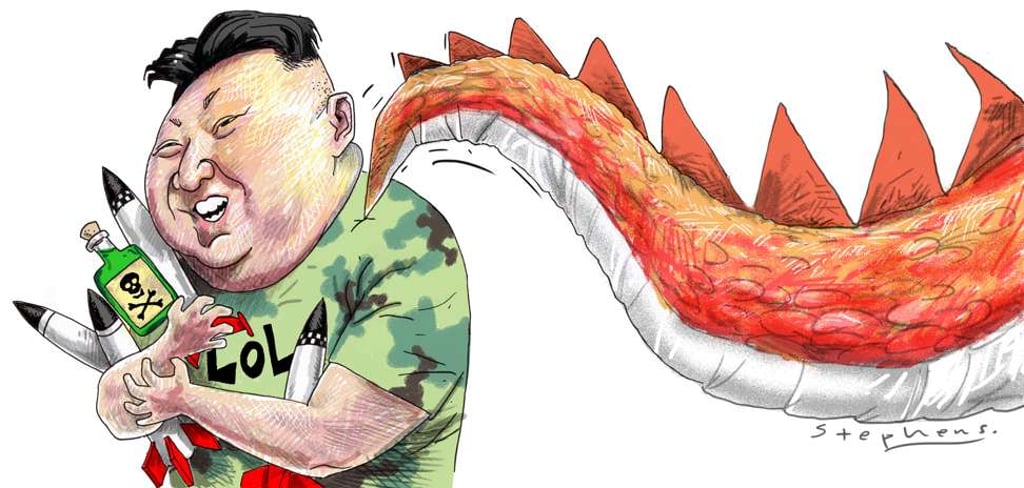
Although China has often emphasised the need for “stability” on the Korean peninsula, it is clearly fed up with Kim Jong-un’s nuclear-and-missile programme, amid a non-stop purge of his enemies. Illustration: Craig Stephens
The picture of a woman wearing a T-shirt inscribed with “LOL” surely offers an enduring memory of the murder of the older half-brother of North Korean leader Kim Jong-un at Kuala Lumpur International Airport. That T-shirt has mesmerised internet surfers, to whom the demise of a lone North Korean might otherwise remain a little noted “act of terrorism” in a distant land.

The acronym LOL, or “laugh out loud”, now symbolises the killing of 45-year-old Kim Jong-nam for which the North Koreans are widely believed responsible. The Chinese are showing their outrage over the assassination – and North Korea’s test of a new mid-range missile – in their startling refusal to accept more coal imports from the North at least until the end of this year.

Korean Peninsula set to become more volatile after China stops buying coal from North

China appears determined to maintain this harsh restriction – in line with UN sanctions but more emphatic than expected – despite the risks to the North Korean regime. Although China has often emphasised the need for “stability” on the Korean peninsula, it is clearly fed up with Kim Jong-un’s nuclear-and-missile programme, amid a non-stop purge of his enemies, but will it really risk the calamity that might befall his regime if he no longer has the financial resources to maintain control?

Advertisement
It’s always possible to gloss over the wave of killings inflicted on Kim Jong-un’s domestic foes, but the assassination of Kim Jong-nam, his half-brother, was an outrage that China could not ignore. His killing was a direct challenge to the Chinese, who had been protecting him, his second wife and his son and daughter in Macau against repeated attempts – presumably on orders from Jong-un, 12 years his junior – to get rid of one seen as a threat.

Why does everybody assume Kim Jong-un killed his brother?

The Chinese, to be sure, could not have seriously contemplated a show of force, or a staged uprising in which the older half-brother would replace the younger in the seat of power in Pyongyang.

Advertisement
Advertisement
Select Voice
Choose your listening speed
Get through articles 2x faster
1.25x
250 WPM
Slow
Average
Fast
1.25x