Regina Ip says the city’s past success has made us blind to how much – and how fast – others are improving, not least the mainland and its embrace of technology and the new economy. Hong Kong has fallen behind simply by standing still
The budget debate in the Legislative Council provides pan-democratic legislators with an annual opportunity to indulge in their favourite pastime of bashing government officials for acts of negligence or malfeasance in the past year. Calls for senior government positions to be deleted or for salaries to be deducted rained down on waxwork-like officials like missiles on hapless targets. Yet amid the thunder of denunciations, the crucial question pertaining to Hong Kong’s economic future has been missed – why is Hong Kong’s economy listing and what are its future directions?
Despite the government’s ability to keep piling up record surpluses, there is a feeling in the community that Hong Kong’s economy peaked in 1997. Twenty years on, many people share the feeling that they are neither happier nor living better than before.
Property prices have skyrocketed, far outpacing increases in real wages. Hong Kong people are unable to buy homes, or have to content themselves with living in “nano-size” cubicles. Hong Kong people watch helplessly as wealthy mainlanders snap up properties and school places in elite school districts. While the government continues to tout Hong Kong as Asia’s premier business and financial hub, an increasing number of overseas-educated mainland graduates, with mother-tongue fluency in English, Putonghua and their native dialects, swell the senior ranks of banks, and consulting and law firms, professions which used to be the exclusive reserves of Hong Kong’s brightest and best.
Advertisement
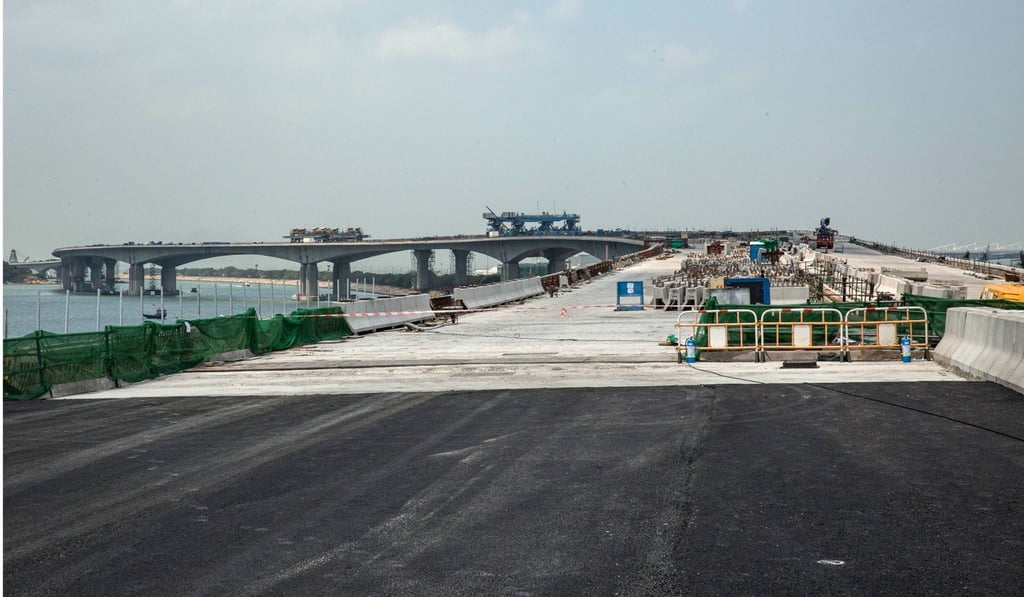
A section of the Hong Kong-Zhuhai-Macau bridge under construction in Hong Kong, in March. Hong Kong lags behind its mainland counterpart in completing its portion of the project. Photo: Bloomberg
Even Hong Kong’s construction industry, which has won admiration across Asia for its ability to pull off mega infrastructure projects in record time, is finding its reputation shattered as Hong Kong lags woefully behind its mainland counterpart in completing the Hong Kong portion of the Hong Kong-Zhuhai-Macau bridge project. Engineering troubles, cost overruns, time delays and 10 workers killed thus far in avoidable industrial accidents have rendered the bridge a pathetic symbol of Hong Kong’s inability to regain its past glory.
Advertisement
One does not need to look at hard economic data to appreciate how pitifully Hong Kong is lagging behind its mainland neighbours in development and innovation. Two examples from daily life speak volumes about Hong Kong’s apparent loss of its ability to innovate. On the mainland, the mobile payment system by WeChat Pay has all but replaced cash transactions, while in Hong Kong, customers at food courts and beauty counters in shopping malls have to queue to pay before they can get their food or merchandise. The vast efficiency gains of the mainland system are self-evident.