Advertisement
Belt and Road Initiative
Opinion

Why Xi Jinping’s belt and road rhetoric of inclusion rings hollow among the Muslim Uygurs of Xinjiang

Michael Clarke says the creation of a veritable police state in Xinjiang, along with curbs on religious freedoms, is fuelling alienation and even radicalisation among Uygurs, amid concern over whether greater trans-Eurasian connectivity will help to channel jihadist tendencies

Reading Time:2 minutes
Why you can trust SCMP
An anti-terror exercise by security forces in Xinjiang in February. Xinjiang’s location has always made Beijing vigilant about its security and apt to respond with a heavy hand to outbursts of anti-state violence or unrest. Photo: Handout
Michael Clarke

President Xi Jinping’s (習近平) Belt and Road Initiative seeks to make China the hub of trans-Eurasian economic connectivity . It will “benefit people across the world”, based as it is on the “Silk Road spirit” of “peace and cooperation, openness and inclusiveness, mutual learning and mutual benefit”, as Xi told Beijing’s Belt and Road Forum last month.

While such rhetoric may boost China’s diplomatic position, it may ring hollow in its own Eurasian frontiers, such as Xinjiang.
Just this week, Xinjiang media reported the staging of mass “anti-terror rallies” involving six million people. This follows coordinated “anti-terrorism oath-taking rallies” in February by thousands of security forces in Kashgar and Khotan, and the provincial capital, Urumqi, where regional party boss Chen Quanguo exhorted forces to “bury the corpses of terrorists in the vast sea of a people’s war”.
Advertisement
Thus, as Xi hails the openness and inclusiveness of the belt and road, a pervasive “security state” has arguably enveloped Xinjiang.
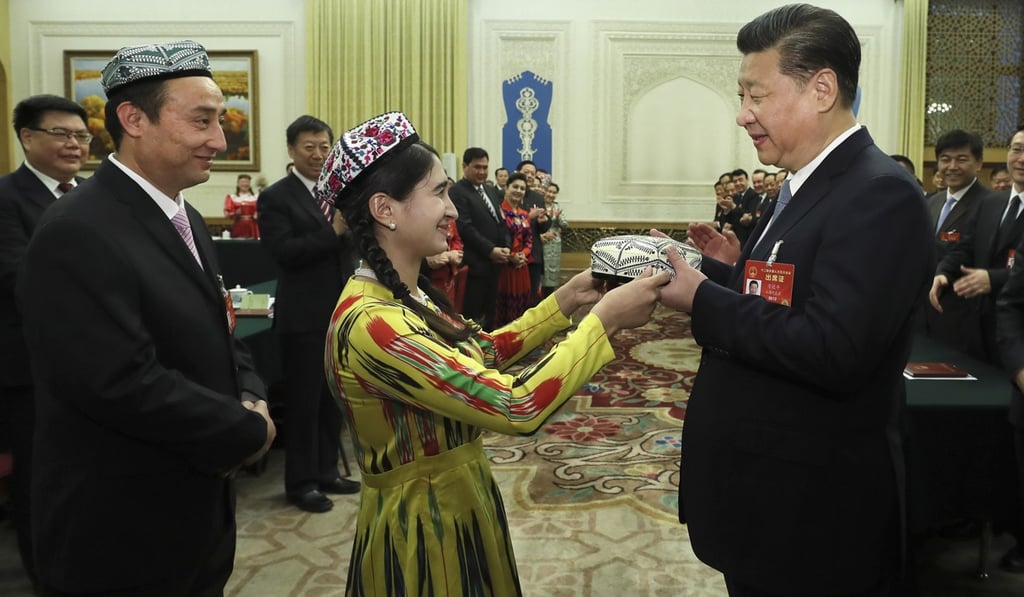
Xi Jinping receives a traditional Uygur hat, a gift symbolising the highest respect and best wishes from people of all ethnic groups in Xinjiang, as he joins a panel discussion with deputies to the 12th National People's Congress from the Uygur autonomous Region, in Beijing on March 10. Photo: Xinhua

Passports taken, more police, as Chen Quanguo acts to tame Xinjiang

Xinjiang’s geopolitical position – bordering Russia, Mongolia, the Central Asian republics, Afghanistan and Pakistan – has always made Beijing vigilant about, and apt to respond with a heavy hand to, anti-state unrest. However, the region’s role as a hub for three of the six belt and road economic corridors linking China with Central Asia, South Asia and the Middle East, has elevated “stability” to a strategic priority.

Under Xi’s watch, Xinjiang has seen long-standing strategies of control bolstered by innovations to extend state monitoring
Under Xi’s watch, Xinjiang has seen long-standing strategies of control bolstered by innovations to extend state monitoring, including “comprehensive supervision” via the Skynet electronic surveillance system in major urban areas, GPS trackers in all vehicles, and provision of DNA samples and biometric data for passports.
Advertisement
Select Voice
Choose your listening speed
Get through articles 2x faster
1.25x
250 WPM
Slow
Average
Fast
1.25x