Advertisement

Opinion | How China ensured a lasting legacy for Nobel Peace laureate Liu Xiaobo

Cary Huang wonders whether Liu Xiaobo would have gone from scholar to internationally recognised Nobel Prize winner, had Beijing not harshly sent the rights activist to prison for 11 years over a pro-democracy manifesto

Reading Time:3 minutes
Why you can trust SCMP
Protesters call for the release of Liu Xiaobo outside the Chinese embassy in central London on July 1. News broke earlier in the week that Liu had been released to a hospital on medical parole after being diagnosed with terminal liver cancer. Photo: AFP

No prize in the world is as well-known and well-respected as the Nobel Peace Prize. Thus, it would be a bad tactic for any government to treat a winner as an enemy, or worse, help make their enemy a winner.

But Beijing did help to make Liu Xiaobo (劉曉波) a Nobel Peace laureate in 2010, despite having declared him an enemy of the state.

I made such a bet immediately after news broke that a Chinese court had convicted and sentenced him on Christmas Day in 2009.

Advertisement
Was Liu the most prominent leader of the year in view of his contribution to the progress of peace in China or the world? Not necessarily. He was then unknown even to most Chinese. A literary critic, writer and professor, Liu was just an acclaimed academic scholar before his involvement in politics. He would not have received the world’s most prestigious award if Beijing had been more low-key in dealing with him.

Liu Xiaobo reunited with family outside jail for first time in 8 years

But Liu had been in and out of jail since 1989, which showcased his dogged resilience and steadfast belief, as well as his consistency and persistence in fighting for what he believed in. He was first jailed for his role in supporting the pro-democracy movement in 1989, and imprisoned again in 1995 for campaigning for political reform. He was last arrested in 2008 and received a harsh 11-year sentence for co-authoring Charter 08, a pro-democracy manifesto calling on the Communist Party to uphold the commitments made in its own constitution.
Advertisement
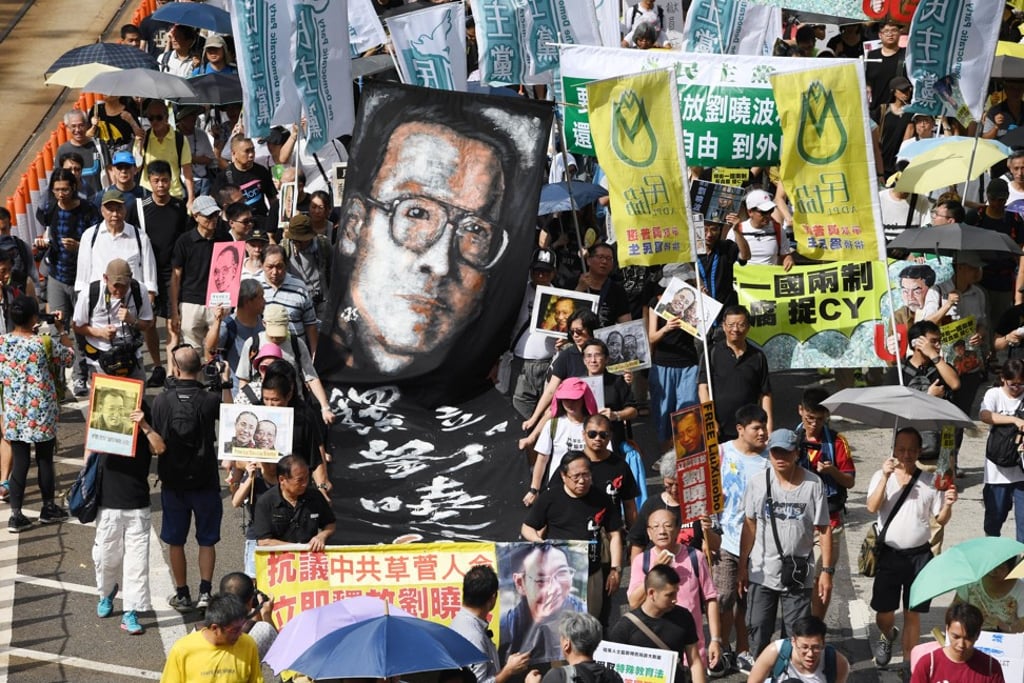
Pro-democracy protesters demand freedom for the terminally ill Liu Xiaobo during the July 1 march in Hong Kong this year. Photo: Kyodo
Indeed, as we discussed Liu’s fate after he was released on medical parole, Professor David Shambaugh, a leading sinologist at George Washington University, said he preferred to place him in the tradition of intellectuals dating back to the May Fourth Movement of 1919. Shambaugh believed that Liu was among many Chinese intellectuals who were fighting for freedom of speech, assembly and association, with the belief that such qualities are closely related to national strength, advancement in the sciences, modernity and people’s happiness.
Advertisement
Select Voice
Choose your listening speed
Get through articles 2x faster
1.25x
250 WPM
Slow
Average
Fast
1.25x