Advertisement
Asean
Opinion

Why China and the US cannot afford to ignore Asean

Tom Plate says neither great power can afford geopolitical myopia, if China seeks stability in the neighbourhood and America wants to ensure that ignorance does not lead to greater distance with the region


Reading Time:4 minutes
Why you can trust SCMP
Tom Plate says neither great power can afford geopolitical myopia, if China seeks stability in the neighbourhood and America wants to ensure that ignorance does not lead to greater distance with the region
Tom Plate
The Asean should be a diplomatic instrument for Beijing to want to work with, rather than break. Illustration: Craig Stephens
The US public rarely gives Indonesia, the most populous country in Southeast Asia, more than passing thought, and even then might be thinking about nothing more than a vacation in Bali. Yet, the world’s fourth most populous nation, home to more Muslims than any other country, more than in the entire Arab world, is one huge growing deal.

Trust me: my suntan-lotion caricature is only a slight libel on America’s grasp of global reality. Save rare exceptions – late diplomat Richard Holbrooke and former US secretary of state Colin Powell come to mind – even foreign-policy potentates tend to psychologically lock their gaze across the Atlantic, in the fashion of France’s famously ­narrow-minded Maginot Line. Even our vaunted pivot to Asia turned into little more than a China pit-stop.
Southeast Asia’s key multinational institutional presence is the Asean, hitting its 50th birthday next month. To be sure, Nato it is not; then again the Association of Southeast Asian Nations, with a coordinating secretariat in Jakarta, reflects the consensus views of 10 nations whose aggregate population of 650 million is half of China’s and twice that of America. That’s something.
Advertisement
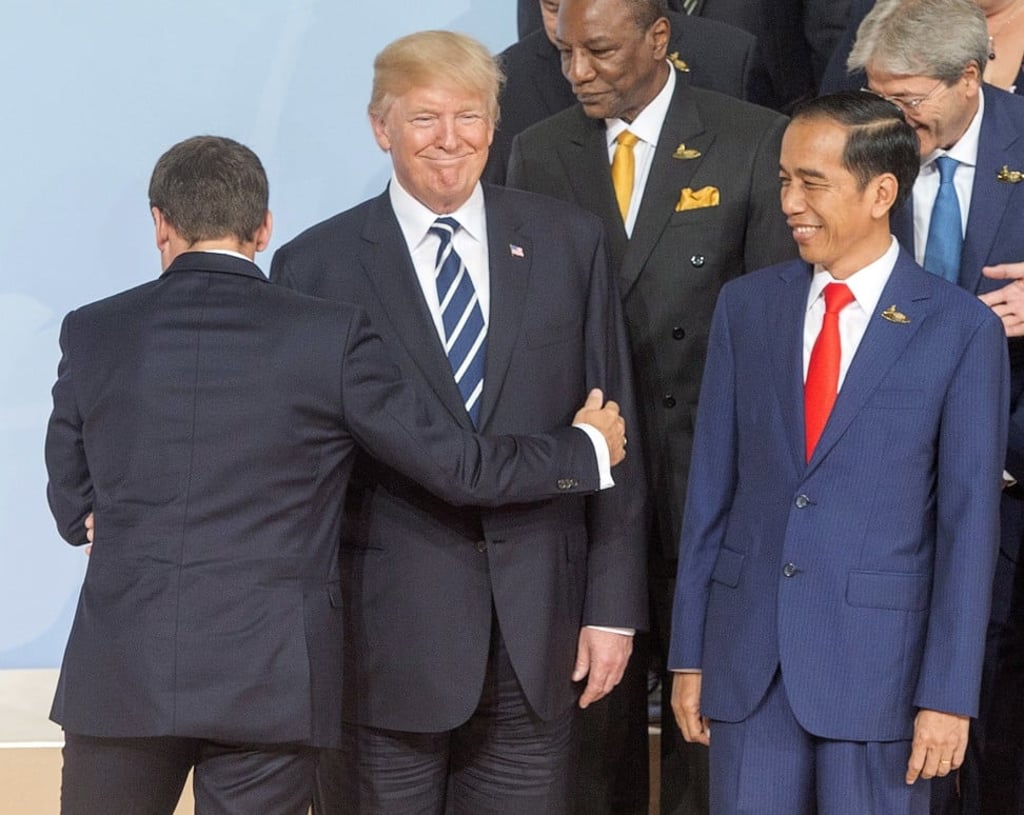
US President Donald Trump gets a hug from his French counterpart, Emmanuel Macron, as Indonesian President Joko Widodo looks on, as G20 leaders gather for a photo on the first day of their summit in Hamburg, on July 7. Photo: AP

Big power snubs and missteps in Southeast Asian diplomacy are ­recounted with professional polish – and a splash of relish – by Kishore Mahbubani in The Asean Miracle (his latest, written with diplomat/writer Jeffrey Sng). The book lays out almost everything important about the current state of Southeast Asia, especially a well-documented portrait of major-power geopolitical myopia, in China but especially in the US, even in the supposedly well-informed academic community: “Many American social scientists on Southeast Asia who seem to rely primarily on New York Times press clippings for raw information on the region,” they write, “do not really know well the societies of Southeast Asia.”

Smaller Asian nations are seeking recalibration ... in this roiling era of a rising China and a flatlining America
This critiqueof Anglo-Saxon views has long been a trademark touch of Mahbubani, a celebrated Singaporean career diplomat who in 2004 became the founding dean of the Lee Kuan Yew School of Public Policy at the ­National University of Singapore, often ranked Asia’s No 1. His range of thought is vital to comprehend today’s world politics. Ethnic Indian and Singapore-born, he caught the diplomatic world’s eye during his first tour as Singapore’s United Nations ambassador in the 1980s, in an era when the controversial Lee Kuan Yew was prime minister.
Advertisement
Select Voice
Choose your listening speed
Get through articles 2x faster
1.25x
250 WPM
Slow
Average
Fast
1.25x