-
Advertisement
Occupy Central
Opinion

Hong Kong must safeguard ‘one country’ for the sake of ‘two systems’

Andrew Leung says young Hongkongers’ identity crisis stems from a weak sense of nationhood, and a clever strategy to better protect ‘two systems’ would be to build trust with Beijing and benefit from its economic progress

Reading Time:4 minutes
Why you can trust SCMP
Around 50,000 protesters gather outside the then Legislative Council building to demonstrate against chief executive Tung Chee-hwa’s handling of an anti-subversion bill based on Article 23, on July 9, 2003. That came days after 500,000 people joined the annual July 1 march to make it the city’s largest ever protest. Photo: SCMP Pictures
Andrew Leung
Following a sizeable protest march in support of Hong Kong’s recently jailed young democracy activists, shrill cries of foul play were heard in certain leading Western media, over perceptions of Beijing’s pressure on local judges and references to “Hong Kong’s political prisoners”.

Hong Kong as a British colony was noted for its political apathy: any anti-colonial stirrings were firmly suppressed. The city’s raison d’etre was to make money. Now, under “one country, two systems”, the people of Hong Kong are no longer content with their bread and butter. Our younger generation is full of higher ideals and aspirations. We should be proud of such hallmarks of a world-class city.

Hong Kong’s “one country, two systems” is enshrined in the Basic Law, enacted as China’s national law. Under the Basic Law, there are many safeguards for the “two systems”. But there are a few safeguards for the “one country”, including Article 23 against subversion and sedition. Even the most democratic countries have such national security legislation. Because of a massive protest against its enactment, Article 23 has so far not become law.

Carrie Lam calls for national security law push
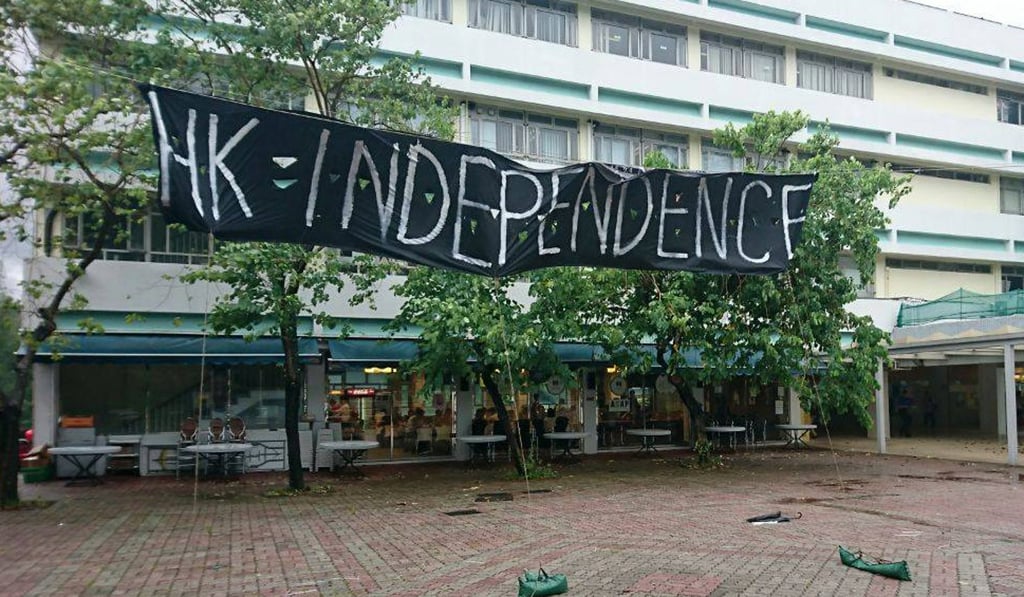
After 150 years of British rule, the younger generation has a weak sense of nationhood. They also have a tenuous empathy with China’s history, including its century of foreign humiliation. Most regard themselves as only Hong Kong people, not Chinese nationals. Previously, Hong Kong was relatively isolated from the mainland economically and socially. Now, there is a flood of mainland visitors and capital. This aggravates the sense of erosion of Hong Kong’s identity, leading to movements for “self-determination” and even “independence”.
Advertisement
An independence banner is displayed at the start of the new academic year, at the Chinese University of Hong Kong in Sha Tin on September 4. Photo: Handout

Without the protection of Article 23, Beijing is understandably wary. There is also the suspicion of the involvement of Western powers in a perceived US-led strategy of containing China.

Advertisement

Moreover, the pan-democrats (some with apparent ties to the US) were emboldened by having secured control of the over-one-third blocking votes in the legislature. Added to filibustering tactics, this has seen essential legislation remain bogged down, detracting from Hong Kong’s long-term competitiveness.

Advertisement
Select Voice
Select Speed
1.00x