Advertisement
US-China relations
Opinion

US-China clash of civilisations is being played out in the South China Sea

Mark Valencia says the hard and soft power confrontation between the two has all the makings of an existential contest because both see it as their right and destiny to dominate and shape the international order. A clash may be inevitable

Reading Time:5 minutes
Why you can trust SCMP
Mark Valencia says the hard and soft power confrontation between the two has all the makings of an existential contest because both see it as their right and destiny to dominate and shape the international order. A clash may be inevitable
Mark J. Valencia
Both China and the US boldly interpret international norms and rules, like the law of the sea, in a way that furthers their national interest. Illustration: Craig Stephens
The struggle between the US and China for control of the South China Sea is symptomatic of a much deeper “clash of civilisations”. According to Samuel Huntington, the originator of this theory, human conflict has transitioned to a new phase in which formerly dominated, abused and exploited cultures and nations of the non-Western world have increasingly become significant players in shaping the international order. The Sinic culture led by China is prominent among them. This possibly existential contest between it and the West – led by the US – is being played out in the South China Sea.

Indeed, their face-off is a stark contrast of political and economic systems and their underpinning raison d’etre. The outcome of this clash of cultures and self-images is important. It is why the competition between the two in general, and in the South China Sea in particular, is being so carefully watched by those likely to be directly and immediately affected.

The US-China hard and soft power confrontation in the South China Sea is driven by a fundamental disconnect, in that they both see themselves as “exceptional” nations that have the “heaven-sent” mission to lead humanity. Each considers it their right and destiny to dominate and shape the international order to fit their needs.

Advertisement

As such, they boldly interpret international norms and rules, like the law of the sea, in a way that furthers their national interest. As prominent American strategic thinker Graham Allison puts it, to China, the rules-based international order is an “order in which America makes the rules and others obey the orders”. For both, the existing international norms and rules do not apply if their observance would thwart the pursuit of their national interest.

Is war between China and the US inevitable? A new book looks to the past for answers
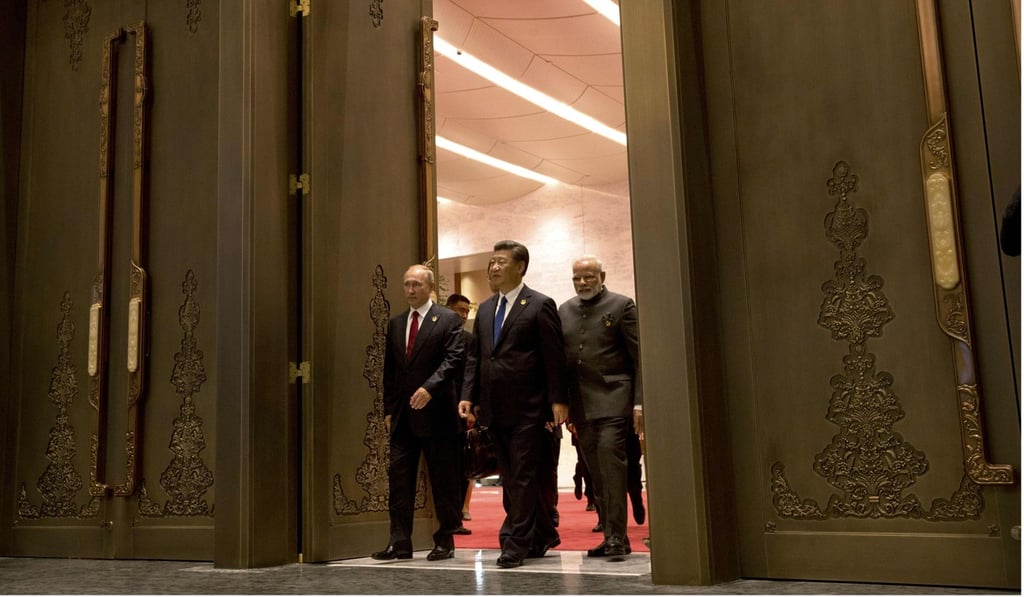
President Xi Jinping leads his guests, Russian President Vladimir Putin and Indian Prime Minister Narendra Modi, into a meeting on the sidelines of the BRICS Summit in Xiamen, Fujian province, on September 5. China wants to be accepted as China, not as an honorary member of the West. Photo: AFP

China chafes at lectures on ‘rules-based order’, as US breaks all the rules

Advertisement
Select Voice
Choose your listening speed
Get through articles 2x faster
1.25x
250 WPM
Slow
Average
Fast
1.25x