Thailand’s hot money problem: echoes of the 1997 Asian financial crisis
William Pesek says a strong baht doesn’t change the fact that Thailand’s military leaders need to make sweeping changes befitting a modern economy to compete with Asian heavyweights
When Thai General Prayuth Chan-ocha grabbed power in May 2014, he thought his battle was against political chaos and corruption. Turns out, it may be with currency traders.
Bangkok is seeing a bull market in irony: Thailand is three-plus years into military rule, its growth lags behind that of the Philippines and Indonesia, and it lacks a savvy strategy to compete with China. Yet, so far in September, the baht has pulled in more overseas investment than India, Indonesia and South Korea combined. Prayuth faces an embarrassment of riches that may seem eerily familiar to students of the 1997 Asian financial crisis.
The latest junta to grab power set out to wash all remnants of Thaksin Shinawatra, a prime minister removed by an earlier coup in 2006, from public life. Thaksin earned comparisons to Italy’s Silvio Berlusconi and, more recently, Donald Trump: a populist billionaire-politician weakening government institutions to benefit family businesses. Even from exile, Thaksin whipped up massive street protests. His baby sister, Yingluck Shinawatra, even became prime minister from 2011 to 2014 before being tossed out.
Advertisement
Thaksin’s sales pitch in 2001 was Trumpian: to overcome losses in living standards and foreign direct investment from 1997, Thailand needed a dealmaking businessman. Yet Thaksinomics focused on buying loyalty through populist handouts to rural communities, not structural reforms. In 2006, military leaders showed Thaksin the door.
Eight prime ministers and myriad protests later, Prayuth grabbed power to cleanse the system. In a strange twist of fate, though, Prayuth is grappling not just with the Thaksin era’s legacy, but also the 1997 Asian crisis. The baht’s 8 per cent surge this year has “hot money” written over it. The cost of insuring five-year Thai debt against default risks is lower than Spain, a developed eurozone economy. Thai bond yields are below South Korea’s, a far more advanced economy.
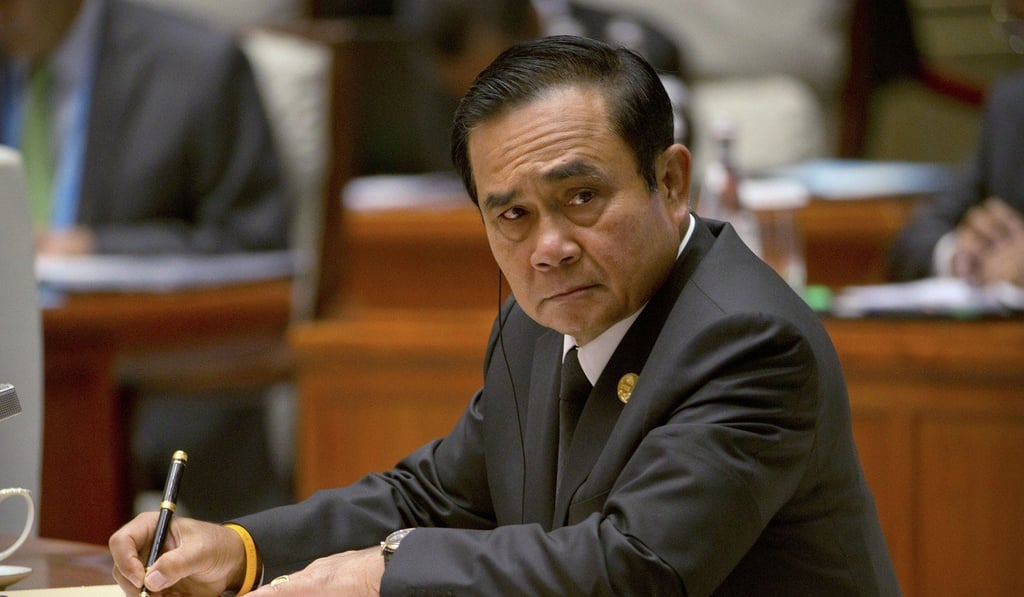
Thailand’s Prime Minister Prayuth Chan-ocha attends the Dialogue of Emerging Market and Developing Countries in Xiamen, southeast China, on September 5. Photo: Reuters
There are some justifications for baht buying. Bangkok’s current-account deficit is around 10 per cent of GDP and booming tourism has caught investors’ attention. Trouble is, those capital flows outpace Prayuth’s reform progress or Thailand’s ability to absorb them productively and safely.