Advertisement
China’s Communist Party
Opinion
Cary Huang

Opinion | How ‘Communist’ China has embraced capitalism but remains Leninist at heart

Cary Huang says that on the 100th anniversary of the Russian revolution, Beijing’s silence on Lenin’s legacy displays both a rejection of his economic priorities and an embrace of a totalitarian authority

Reading Time:2 minutes
Why you can trust SCMP
Framed portraits (from the left) of German philosopher Karl Marx, Soviet Union founder Vladimir Lenin, and China’s former leaders Mao Zedong and Deng Xiaoping hang above a screen showing a news broadcast of China's President Xi Jinping, as Communist Party members gather to watch in Wenzhou, Zhejiang province, on October 25. Photo: Reuters
No foreign politician or event in the past century has changed China’s economic and political configurations as profoundly as Vladimir Lenin, the founder of the Soviet Union, and his Bolshevik revolution.
Leninism and the outbreak of the Russian revolution in 1917 have a causal relationship with the birth of China’s Communist Party in 1921 and the founding of the People’s Republic of China in 1949. As Mao Zedong said: “The salvoes of the October revolution brought Marxism-Leninism to China.”
But the world’s largest, most powerful Communist Party has turned a cold shoulder to this momentous event, even though Leninism is enshrined as the party’s official ideology. The centenary anniversary, on November 7, went all but unnoticed in the world’s last major communist-ruled nation, with no official events.
Advertisement
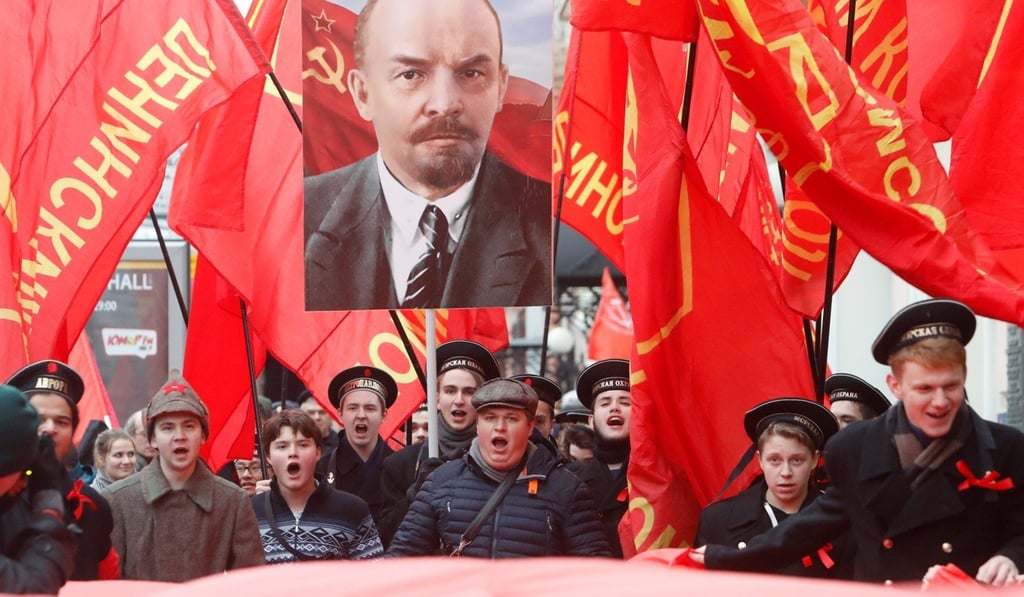
Demonstrators carry flags and a portrait of Soviet founder Vladimir Lenin during a rally held by the Russian Communist Party to mark the revolution's centenary in central Moscow on November 7. Photo: Reuters

Analysis: How Xi Jinping revived old methods by abandoning intraparty democracy

Leninism has played a much greater role in China than the original theories of Karl Marx and Friedrich Engels, for the Russian leader’s interpretation of Marxism inspired Mao to launch the peasant uprising and agrarian revolution. His dogma on the organisation of a revolutionary vanguard party, the revolutionary mobilisation of the masses against “exploiters” and “oppressors”, as well as on the dictatorship of the proletariat, helped shape Mao’s philosophy of rule and transform China. The wholesale execution of enemies inspired Mao’s brutal dictatorship and his launch of the Cultural Revolution under the theory of “continuous revolution under the dictatorship of the proletariat”.

Advertisement
Advertisement
Select Voice
Choose your listening speed
Get through articles 2x faster
1.25x
250 WPM
Slow
Average
Fast
1.25x