Beijing outmanoeuvres US in the South China Sea – at least for now
Mark J. Valencia says Manila’s acceptance of Beijing’s claims in the South China Sea shows that the erosion of US influence is real, though probably overstated by hand-wringing Asia policy pundits
The struggle between China and other claimants for political domination of the South China Sea is over, for now. China has won this round. This is a political setback for the US, which supported the other claimants – Brunei, Malaysia, the Philippines and Vietnam. Indeed, what US President Donald Trump said and did not say during his recent Asian trip and statements emanating from recent Asean-hosted summits convinced many observers that China has gained the diplomatic edge over rival claimants and the US.
The “China wins” perception is reflected in many observers’ comments. Ely Ratner, of the US Council on Foreign Relations, says “the South China Sea has fallen victim to a combination of Trump’s narrow focus on North Korea and the administration’s chaotic and snail-paced policymaking process”. Jay Batongbacal, director of the University of the Philippines Institute for Maritime Affairs and Law of the Sea adds, “Asean countries are willing to move on, failing to make China accountable for the militarisation”.
The US position is that China should fully implement the international arbitration ruling invalidating its claims, adjust them to conform to the 1982 UN Convention on the Law of the Sea and refrain from further “militarising” the features it occupies. The US also demands China respect its “freedom” to undertake intelligence, surveillance and reconnaissance probes in China’s 200-nautical-mile exclusive economic zone, regardless of whether these probes violate China’s laws. The US also wants China to comply with the “rules-based order” it helped to build and benefits from. None of this has happened, or is likely to.
Advertisement
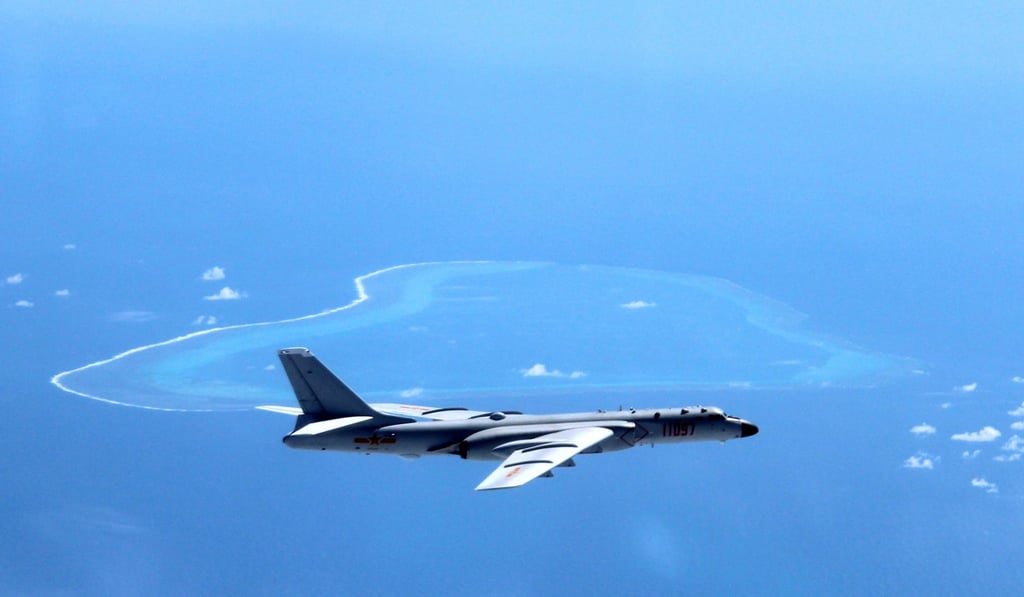
A Chinese H-6K bomber patrols islands and reefs in the South China Sea in May. China's state broadcaster on May 7 showed navy bombers taking part in exercises over the South China Sea, including one involving the detection and expulsion of foreign military surveillance aircraft such as those deployed regularly in the area by the US and others. Photo: AP
Clearly, the other claimants, as well as Asean and the US itself, have suffered setbacks. Under Trump, the US withdrew from the Trans-Pacific Partnership it initiated, abandoned President Obama’s rebalance to Asia and downplayed China’s actions in the South China Sea because it needs Beijing’s help with North Korea. These changes shape Southeast Asia’s perceptions that they are being given short shrift by a withdrawing US being rapidly replaced by China.
Advertisement
This was a remarkable feat for China, using a deft mix of intimidation, economic incentives (China is now Asean’s largest trading partner) and a mix of patience, perseverance and persuasion tailored to each target. China was able to blunt, then bury, its initially devastating loss to the Philippines. The US had supported the Philippines to file the complaint against China in the first place. China was clearly losing the public diplomacy struggle with the US, being labelled as an international outlaw while the US was the upholder of the existing international order.