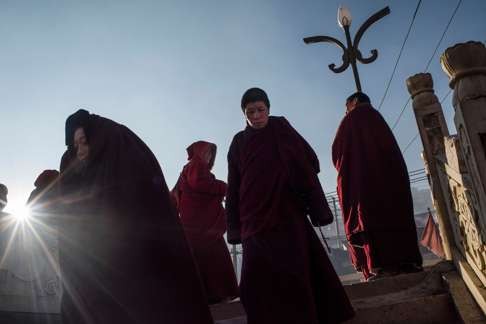
Tibetan Buddhist nuns take up feminism and seek equal status with monks
Change is in the air at world’s biggest Tibetan Buddhist academy, in China’s Sichuan province, as nuns stand up for themselves and for Tibetan women as a whole. Monks appear split on their demands

Religiously devoted and with a shaved head and flowing burgundy robes, Xinde Shijiamouni has all the trappings of a Tibetan Buddhist monk. But her serenity is troubled because, as a nun, she cannot reach the same clerical status as a man.
In the harsh terrain and relative isolation of western China, Tibetan culture has long been patriarchal. Now more than 100 nuns at the Larung Gar Buddhist Institute – the largest Tibetan Buddhist academy in the world – are challenging that, holding study sessions on feminism and sparking a nascent religious movement.
If you look at Buddhist law, you can see both genders should be equal
The group have published a series of books on female Buddhist figures and put out a magazine once a year. But many senior monks view their calls with suspicion, decrying sexual equality as a “Western concept”.
“If you look at Buddhist law, you can see both genders should be equal,” said Xinde Shijiamouni – whose name is a pseudonym meaning “The Heart of the Buddha” – “but many on the outside don’t understand the dharma, and many on the inside choose to ignore it.”
More than 10,000 men and women study at the institute, living in red wooden huts, crammed into a steep valley at 4,000 metres altitude in an ethnically Tibetan part of Sichuan province, that surround the main buildings.