Could you design a new game in 48 hours? These Hongkongers did
When games enthusiasts and designers gathered at the Hong Kong leg of the Global Game Jam to experiment on new ideas, we found out the basics of creating fun

Think of it as a hackathon for games enthusiasts. Given just 48 hours, what engaging new form of play can your team come up with? What are the qualities of a game that will keep us absorbed for hours, even days? At the third Hong Kong Global Game Jam, one presentation that drew wryly appreciative laughter all round was a game called Gung Lau (Cantonese for paying off the mortgage). Players must perform a series of tasks to generate income that will go towards mortgage payments, and failing to meet payment targets will mean losing their properties.
It is the local iteration of Global Game Jam, a series of events introduced in 2009 by a group of developers. Open to all, the jams have grown steadily since then, attracting not only amateurs (artists, students and others) but also professional game designers and programmers to 518 events in 78 countries this year.
If the whole concept seems like yet more work for the pros who are already doing that in their day jobs, Hong Kong organiser Hanna Wirman says the appeal lies in its format, which pushes participants to think beyond traditional gaming norms.
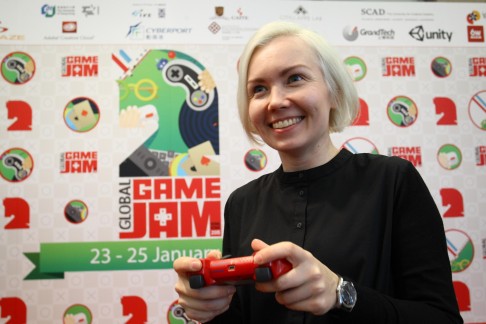
"It creates an opportunity for professionals to do something they don't usually do and for students to actually complete a game," says Wirman, a research assistant professor of game development at Polytechnic University. "For professionals, they know about the market, what's in line with their existing products. But with Global Game Jam, they can try something that's not safe."
After all, the founders' idea was to bring people together to come up with innovative new ideas, and collaborate and experiment on different concepts and formats for games (including non-digital varieties). That's why participants are asked to create games around fuzzy themes such as "As long as we have each other, we will never run out of problems" (2009) and "Sound of a Heartbeat" (2013).
This year's theme, "What do we do now", yielded a typically freewheeling spectrum of possibilities. Many featured apocalypse-type scenarios involving multiple players who must work together to escape a monster, fend off an alien invasion, or convince different countries to help save the earth.