Anger of China’s middle class over education system is growing, and with it their political consciousness
Recent protests over a transfer of university places from Jiangsu students to those from poorer provinces reflect rising resentment of China’s elite among class that’s a bedrock of Communist Party support

It is a cold January evening in Nanjing, the capital of China’s Jiangsu province, and the sun is just about to dip below the city’s grey horizon as the students of Tianjiabing high school trickle sluggishly from their classrooms.
At the school gate, their parents – some chatting in hushed tones, some still rolling in silently on electric scooters – are waiting. One girl, in her last year of school, stands behind the accordion gate talking to her mother, from whom she receives words of encouragement and home-cooked dinner in a plastic box; the girl, who will take the college entrance exam (gaokao) in just five months, must stay in class for another four hours. She reaches her arms over the gate and waves in an exaggerated farewell gesture to a friend in the year below who is going home for the day; the life of Chinese high schoolers is suffering, and they know it.
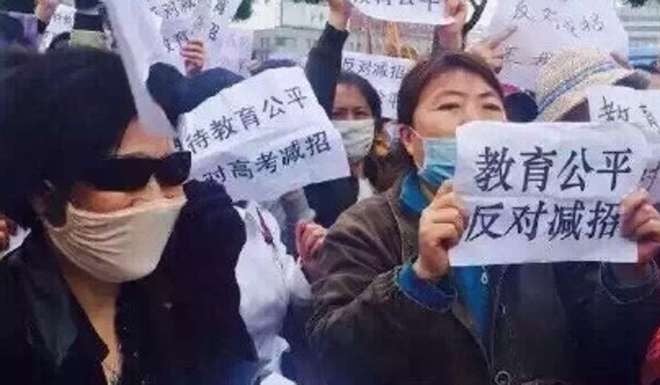
Their parents know it too, and it’s why many of them – from Tianjiabing and other high schools – took to the streets last May to protest at an announcement handed down from Beijing that wealthy Jiangsu on the country’s east coast would be allocating 38,000 spots in its tier-one universities to students from 10 poorer inland provinces instead of to Jiangsu children.
Jiangsu’s students about to sit the exams are suffering in their classrooms until 9.30pm every day, but they are giving more opportunity to students from the backwards provinces
The day after the announcement was issued, more than 1,000 parents flooded the area around the provincial Ministry of Education, shouting and carrying signs that read “Fairness in education! Oppose the gaokao admissions reduction!” Videos and photos shared on social media showed local police arresting, beating and carrying off incensed parents; and there was at least one report of self-immolation – a popular, and often less than fatal, tactic of rage in China. Similar protests occurred in 13 cities across Jiangsu as well as in the populous and rich Hebei, the other province hit hardest by the quota reduction.