Cambridge University study centre focuses on risks that could annihilate mankind
Research group focuses on synthetic biology, artificial intelligence and environmental threats

Consider these two scenarios - supercomputers take over the world, destroying their human creators; or else a man-made virus is released, wiping out life on earth. They may sound like the plots of Hollywood sci-fi films, but "existential risks" are real and deserve serious study, say the founders of a new centre at Cambridge University.
"The main threats to sustained human existence now come from people, not from nature," says Martin Rees, Britain's Astronomer Royal and one of the centre's co-founders.
Together with co-founders Jaan Tallinn, one of the brains behind Skype, and Huw Price, professor of philosophy at Cambridge University, Rees presented the CSER's first public lecture on existential risk last month.
Rees, a distinguished astrophysicist, has been concerned about existential risk for more than a decade. His 2003 book Our Final Hour looked at the chance of the human race surviving the 21st century - and the conclusion was unsettling, putting the chance of civilisation coming to an end this century as high as 50:50.
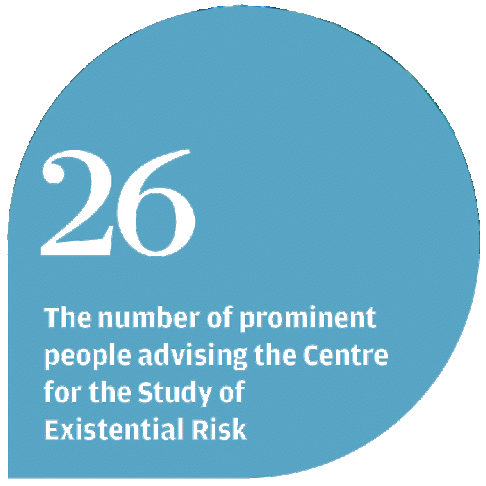
The book was influential. It got a lot of people thinking and talking about existential risk, and the calibre of advisers on the CSER team is testament to how seriously the issue is being taken. Cosmologist Stephen Hawking, economist Partha Dasgupta, zoologist Robert May and geneticist George Church are among 26 scientists who have signed on to support the centre.