Absent Ahok, anti-Chinese sentiment on artists’ minds at Indonesia shows that test the bounds of tolerance
Pointed references to jailed former Jakarta governor contribute to dark mood at exhibitions in capital and Yogyakarta, but atmosphere is lighter at opening of private museum where belief in art as conduit for exchanging ideas is strong

There isn’t a single image of jailed former Jakarta governor Basuki Tjahaja Purnama to be seen, but the man commonly referred to by his Hakka Chinese nickname Ahok looms large at one of the biggest events on the Indonesian art calendar.
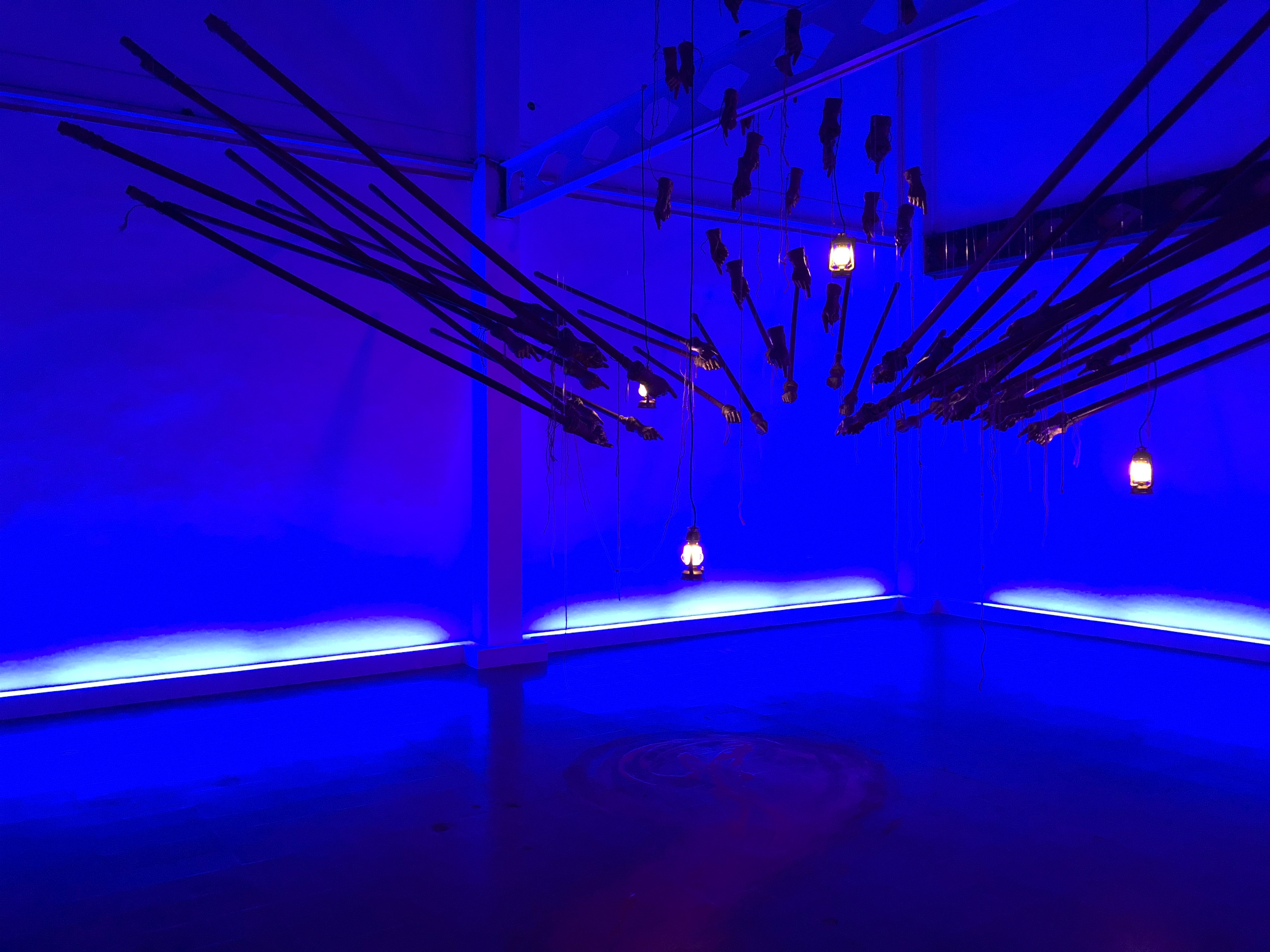
At the 14th Biennale Jogja, a contemporary art exhibition held in the artist-filled city of Yogyakarta, a long smear of reddish brown paint on the floor leads visitors from the entrance of the Jogja National Museum to Timoteus Anggawan Kusno’s The Death of A Tiger (2017).
The title used by the local artist refers to a feudal Javanese sacrificial ritual called Rampogan Macan, in which a crowd of men armed with spears would form a ring round a trapped tiger and kill it for the king’s entertainment.
Here, in a dark room lit by blue light, Mozart’s rousing Requiem blasts from speakers as a funnel of 70 spears descends from the ceiling, each tip replaced by a hand pointing accusingly at the centre of the room, where the painted trail ends in what looks like a swirl of blood.
In another room, Aditya Novali’s When I Google Ahok (2017) consists of six brightly lit panels featuring apparently random, multicoloured rectangles – a representation of online search results. The colour of blood, violence, communism and the Chinese flag, red is nevertheless dominant in the piece.
Both works bring to mind the baying for blood by radical Islamic groups that preceded the May 9 conviction for blasphemy of the Christian and ethnically Chinese former governor, whose jailing brings back memories of the anti-Chinese violence that ushered in Suharto’s New Order in the mid-1960s and ushered it out again in 1998.