China could make first contact with aliens. Would Beijing tell the world? Might it spell doom for the human race?
With the world’s largest radio dish probing ever deeper into space in search of extraterrestrial evidence, we must ask ourselves – is Earth prepared for a time when science fiction becomes fact?

Last January, the Chinese Academy of Sciences invited Liu Cixin, China’s pre-eminent science-fiction writer, to visit its new state-of-the-art radio dish in the country’s southwest. Almost twice as wide as the dish at America’s Arecibo Observatory, in the Puerto Rican jungle, the Chinese dish, named Fast (the Five-hundred-metre Aperture Spherical Telescope), is the largest in the world, if not the universe. Though it is sensitive enough to detect spy satellites even when they’re not broadcasting, its main uses will be scientific, including an unusual one: the dish is Earth’s first flagship observatory custom-built to listen for a message from an extraterrestrial intelligence. If such a sign comes down from the heavens during the next decade, China may well hear it first.
In some ways, it’s no surprise that Liu was invited to see the dish. He has an outsize voice on cosmic affairs in China, and the government’s aerospace agency sometimes asks him to consult on science missions. Liu is the patriarch of the country’s science-fiction scene. Other Chinese writers have attached the honorific Da, “big”, to his surname. In years past, the academy’s engineers sent Liu illustrated updates on the dish’s construction, along with notes saying how he’d inspired their work.
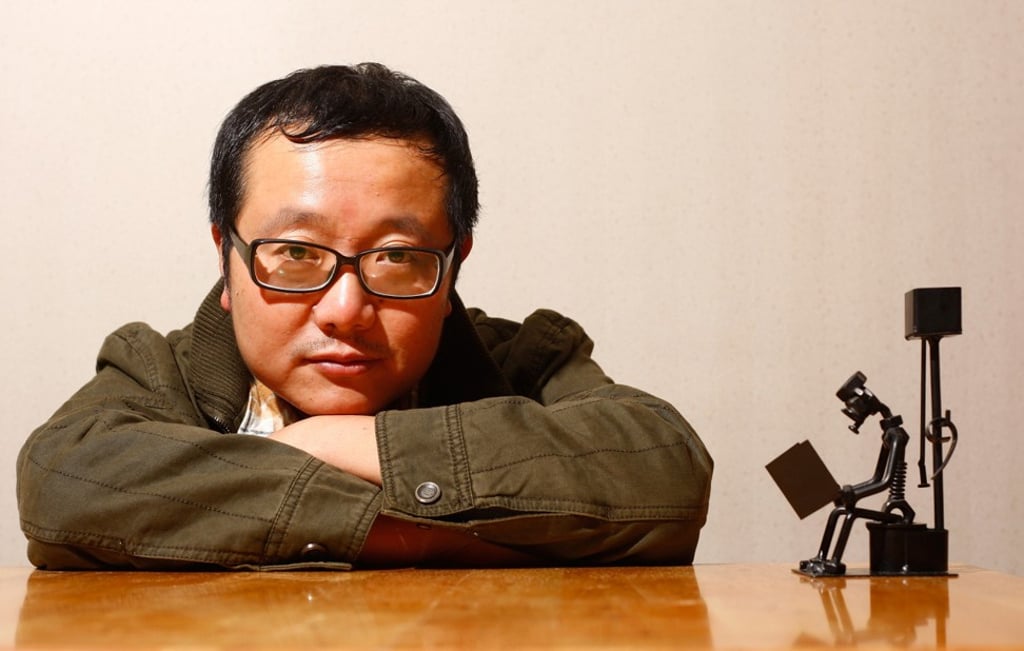
In recent years, Liu has joined the ranks of the global literati. In 2015, his novel The Three-Body Problem became the first work in translation to win the Hugo Award, science fiction’s most prestigious prize. Barack Obama told The New York Times that the book – the first in a trilogy – gave him cosmic perspective during the frenzy of his presidency. Liu said Obama’s staff asked him for an advance copy of the third volume.
At the end of the second volume, one of the main characters lays out the trilogy’s animating philosophy. No civilisation should ever announce its presence to the cosmos, he said. Any other civilisation that learns of its existence will perceive it as a threat to expand – as all civilisations do, eliminating their competitors until they encounter one with superior technology and are themselves eliminated. This grim cosmic outlook is called “dark-forest theory”, because it conceives of every civilisation in the universe as a hunter hiding in a moonless woodland, listening for the first rustlings of a rival.
Liu’s trilogy begins in the late 1960s, during Mao Zedong’s Cultural Revolution, when a young woman sends a message to a nearby star system. The civilisation that receives it embarks on a centuries-long mission to invade Earth, but she doesn’t care; the Red Guard’s grisly excesses have convinced her that humans no longer deserve to survive. En route to our planet, the extraterrestrial civilisation disrupts our particle accelerators to prevent us from making advancements in the physics of warfare, such as the one that brought the atomic bomb into being less than a century after the invention of the repeating rifle.
Science fiction is sometimes described as a literature of the future, but historical allegory is one of its dominant modes. Isaac Asimov based his Foundation series on classical Rome, and Frank Herbert’s Dune (1965) borrows plot points from the past of the Bedouin Arabs. Liu is reluctant to make connections between his books and the real world, but he does say that his work is influenced by the history of Earth’s civilisations, “especially the encounters between more technologically advanced civilisations and the original settlers of a place”. One such encounter occurred during the 19th century, when the Middle Kingdom, around which all of Asia had once revolved, looked out to sea and saw the ships of Europe’s seafaring empires, whose ensuing invasion triggered a loss in status for China comparable to the fall of Rome.