Forget molecular gastronomy - the culinary trend is leaning towards sustainable ingredients

In Asia, the move towards local and sustainable is happening at a slower pace but it is cropping up more
The foodie community gave a collective sob after Ferran Adria's el Bulli closed its doors a couple of years back.
After all, the Spanish wizard had consistently enthralled the gourmet world with his molecular gastronomy - liquid nitrogen experiments, unusual pairings, and ingredients such as "clam meringue" or "fake truffle", concocted in a laboratory setting.
However, in many ways, the culinary movement was already taking its focus in a different direction, an approach that would still prove innovative, but based on sourcing closer to home and with less complicated cooking techniques.
As beautiful as still life paintings, seasonal vegetables sit on a "soil" of malt and hazelnut flour, a quail egg in a bed of hay, and lichen with cep mushrooms on deep green local moss.
Many other restaurants are invested in the same approach, but don't necessarily have Noma's months-long waiting lists and comparable price tags. Amsterdam's De Culinaire Werkplaats, for example, showcases the trend for sustainable ingredients in a different kind of way, a type of restaurant collective that creates tasting menus focusing on a theme, whether art or design-based, or around the concept of food at a particular moment ("blooming" was a recent category), and invites people to eat in a communal type of environment.
"Our criteria for sourcing besides taste and inspiration," explains owner Marjolein Wintjes, "are that at least two of the following criteria are provided in the choice of ingredients and suppliers: animal welfare, small-scale or organic farming, fair trade, direct trade, season, distance [local], and personal health." Even more strikingly patrons pay what they think is fair.
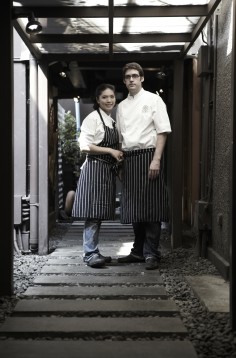
At Roberta's in New York, which was named one of the 20 most important restaurants in the United States by Bon Appetit magazine, hipsters and celebs such as the Clintons gather on benches in a former garage in Bushwick for wood-oven pizza topped with organic veggies, foraged produce and flower salads. The trio of owners have also opened the more upscale Blanca's with a US$180 tasting menu.
"For us, sustainability is a keystone of independence," says one of the owners, Chris Parachini. "It means less dependence on people making things far away where we have no say in the method or the result. It's self-reliance. We get to decide the how and why of what. Where we find kindred approaches we partner, usually just by buying and trading."
Their cookbook, Roberta's, out in October, is also full of art and illustrations born of collaborations with local artists and photographers.