Dutch designer Iris Van Herpen fascinated with movement and change
Dutch fashion designer Iris van Herpen uses 3D printing and the latest technology to create fluid collections
Iris van Herpen has made her name as the alchemist of fashion. Rightfully so, the Dutch designer frequents MIT's material labs and nuclear research compounds for inspirations. In fact, her latest collection, titled "Magnetic Motion", is inspired by her earlier visit to CERN in Switzerland, home of the world's largest particle accelerator.
Shown on the rooftop of Paris' Centre Pompidou, van Herpen's spring/summer 2015 collection is nothing short of hi-tech influences and groundbreaking details, much like the innovative architecture in the background.
Models strutted down the runway in what might have looked like exo-skeletons created via van Herpen's signature 3D printing techniques, injection moulding and laser cutting. There were sheath dresses embellished with honeycomb structures, and shoes "grown" with magnetic technology - each one slightly different - in collaboration with sculptor Jólan van der Wiel. She also worked together with regular collaborator Canadian architect Niccolo Casas on a 3D-printed crystal dress that stole the show.
Asked about her inspirations, van Herpen recalls her visit to CERN. "I have never seen anything as beautiful. It's like looking into the future," van Herpen says. "Motion and movement have always been an inspiration in my work, [such as] dance and metamorphosis." The designer is also fascinated with invisible movements and invisible energies, such as the particle collisions she witnessed at CERN.
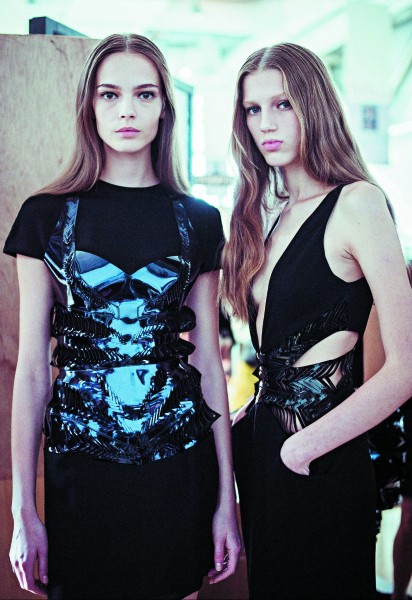
Mesmerised by the fluid and organic movements created by magnetic forces, van Herpen translated the intangible into perfectly wearable fashion.
"I often find the process of my work intriguing," she says. "To see something grow is so much more beautiful than when a garment is finished and silenced. In this collection, I tried to show the process of growth, the powerful force of magnetic attraction and the transformation it creates."
For someone who is heavily involved in high technology, it's interesting that van Herpen says she doesn't think about the future.
"When I design I never think about the future," she says. "By concentrating on this very moment - where there's so much more to see than I can possibly see, where there's so much more to discover than I can possibly discover - I create my future."
The synergy of different forces, van Herpen reckons, is the drive behind her creations.