Beijing’s new highway network connects urban zone twice the size of New York
Opening of 1,000km ring allows people from neighbouring Tianjin and Hebei to reach Beijing within an hour

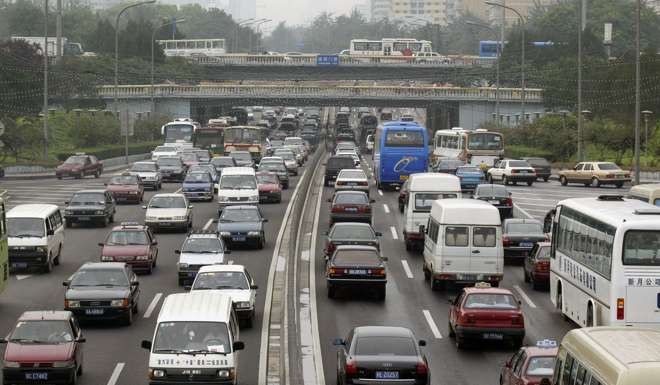
Another ring of highways that extends 1,000km has been built around Beijing, becoming the seventh ring road and completing a key infrastructure project that closely connects the capital with neighbouring Tianjin and Hebei.
Completion of the ring makes it possible for residents of Hebei and Tianjin to travel to Beijing by road within an hour and is expected to foster satellite communities half an hour away. This would create a sprawling urban zone of 270,000 sq km, dwarfing Tokyo, at 35,000 sq km, and New York, at 138,000 sq km.
Cai Jianming, a professor with the Department of Urban and Rural Studies under the Chinese Academy of Sciences, said the highways would not only ease traffic pressure but also prompt the establishment of knots that shouldered some of the non-essential functions of the capital.
The strategy of Beijing-Tianjin-Hebei integration, released in 2014, plans to move some education, logistics and healthcare functions from the capital Beijing to Hebei and towns with specialised functions, and is expected to flourish with more convenient transportation.
“The highways would help the specialised towns. With future development of subways and railways, towns for residents commuting to work in Beijing will also show up,” Cao said.
The G95 national-level highway is composed of 13 highways that connect 13 cities in the region, including Sanhe, Langfang, Zhangjiakou and Chengde in Hebei province, and Beijing and Tianjin.