Why China is reviving Mao’s grandiose title for Xi Jinping
Analyst says the honorific ‘lingxiu’ is unlikely to resonate with the public in the way it did half a century ago

President Xi Jinping has been formally recognised as the ruling Communist Party’s lingxiu – a reverential term for “leader” that was only used during the era of chairman Mao Zedong and his successor Hua Guofeng more than three decades ago.
“General Secretary Xi Jinping is the party’s well-deserved lingxiu, supported by the whole party and loved and esteemed by the people,” the Politburo said at its first meeting on Friday since the country’s new leadership line-up was unveiled.
Lingxiu – a more spiritual, grander term for “leader” than the commonly used lingdao – is an honorific bestowed only on “great lingxiu” Mao, the founder of communist China, and his short-lived successor, “wise lingxiu” Hua Guofeng.
What do you call Xi Jinping? China’s elite echo language of Mao to sing the praises of their ‘leader and helmsman’
Even before the decision-making body confirmed Xi’s lingxiu status, more than a dozen political and military leaders had used the grandiose title to refer to Xi during the twice-a-decade party congress that ended on Tuesday. Observers said that reflected a consensus among the party elite to place Xi at a level of authority above all his predecessors but Mao.
In a further sign of Xi’s entrenched authority, Friday’s Politburo meeting also concluded that the “centralised and unified leadership of the Party Central” was the highest principle of the party’s leadership – a departure from recent decades when “collective leadership” and “democratic centralism” were upheld as the top principles.
It means that Xi, who is the “core” of the Party Central, has been officially recognised as the highest authority – and can override others – on the Politburo Standing Committee. Members of the top echelon of power would have had more say in the past under “collective leadership”.
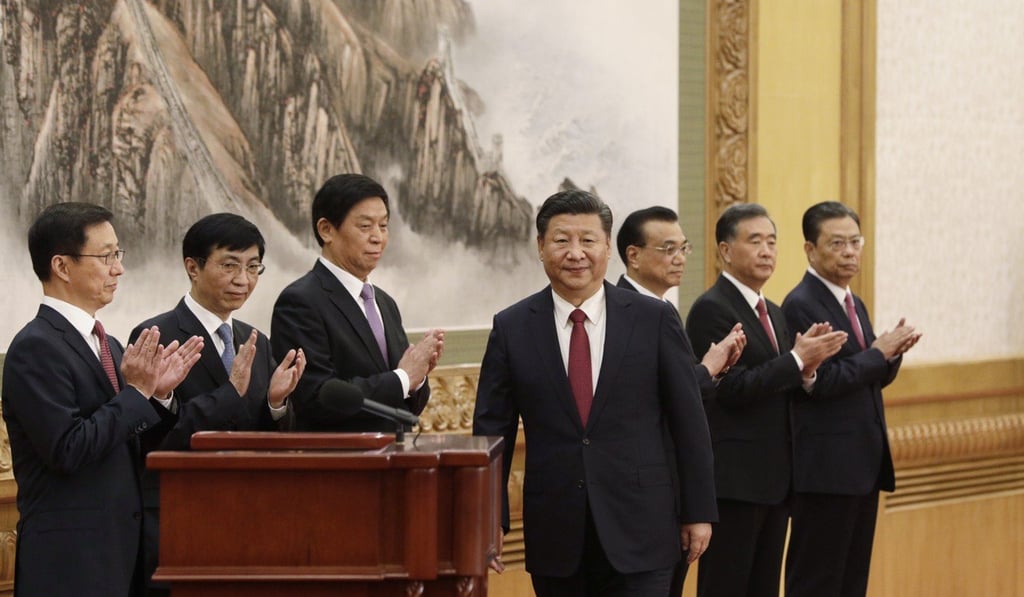
Members of the 25-strong Politburo were also told that they should be the first to safeguard the “centralised and unified leadership” and Xi’s “core” status, and submit a written work report to Xi every year.