Hands-on work beats theory, Hong Kong vocational educators using VR technologies say
Virtual or augmented reality systems allow for an immersive experience in studying aircraft engineering and other subjects

With virtual and augmented reality all the rage in gaming and entertainment industries, Hong Kong’s largest vocational education provider is planning to extend the technologies to wider disciplines to enhance teaching and learning.
At the Institute of Vocational Education – part of the Vocational Training Council – a team recently used the systems, more commonly known as VR and AR, to teach subjects in aircraft engineering and building maintenance.
“Students in safety training as well as those learning complicated procedures will benefit most,” Dr Eric Liu Sai-lok, the council’s academic director of engineering, said.
The systems simulate workplace environments, putting students through situations resembling those in real life.
Students can then undertake different tasks such as identifying safety hazards and conducting machine inspections in virtual plant room and aircraft hangar environments.
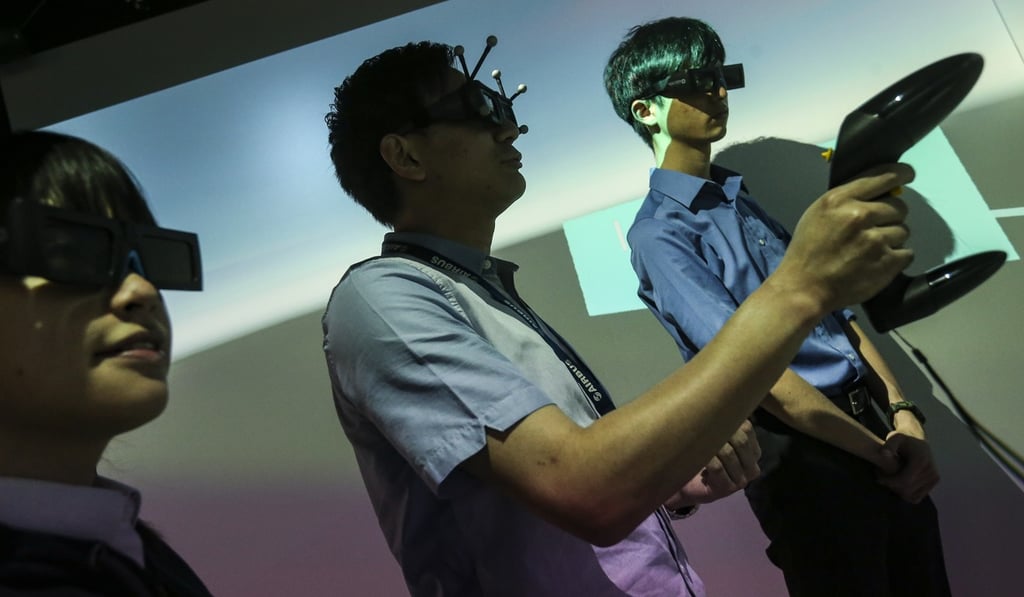
For example, the Cave Automatic Virtual Environment System allows students to examine and manipulate 3D models according to how they function in real life.
Students can also have a go at repairing a leaking hydraulics pump within limited time, with a VR head-mounted display.