Last edge of Greenland ice sheet to resist global warming is now unstable
The last edge of the Greenland ice sheet that had resisted global warming has now become unstable, adding billions of tonnes of meltwater to rising seas, scientists said.

The last edge of the Greenland ice sheet that had resisted global warming has now become unstable, adding billions of tonnes of meltwater to rising seas, scientists said.
In the past, the flow from this ice stream had been constrained by massive buildups of ice debris choking its mouth. But a three-year spell of exceptionally high temperatures removed this blockage - and like a cork removed from a bottle helped accelerate the flow, the study said.
The stream, called Zachariae, is the largest drain from an ice basin that covers 16 per cent of the Greenland ice sheet.
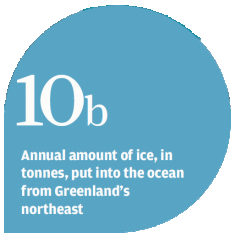
From 2003 to 2012, northeastern Greenland disgorged 10 billion tonnes of ice annually into the ocean, the study found.
"Northeast Greenland is very cold. It used to be considered the last stable part of the Greenland ice sheet," said Michael Bevis, an earth sciences professor at Ohio State University who led the study. "This study shows that ice loss in the northeast is now accelerating. So, now it seems that all the margins of the Greenland ice sheet are unstable."