Astronomers around the world are trying to take the first picture of a black hole

By its very nature, the black hole at the heart of our galaxy is impossible to see. Its overwhelming gravity allows nothing to escape, not even light. Massive enough to send shivers through space-time itself, yet perfectly invisible, it lurks in the darkness like a monster from a child’s nightmare - felt but unseen.
It is the stuff of physicists’ wildest dreams.
“Black holes are basically the most mysterious objects in the cosmos,” said Shep Doeleman, an astronomer at the Harvard-Smithsonian Center for Astrophysics. Even Albert Einstein almost didn’t believe they were real, even though it was his theory of general relativity that helped predict them more than 100 years ago.
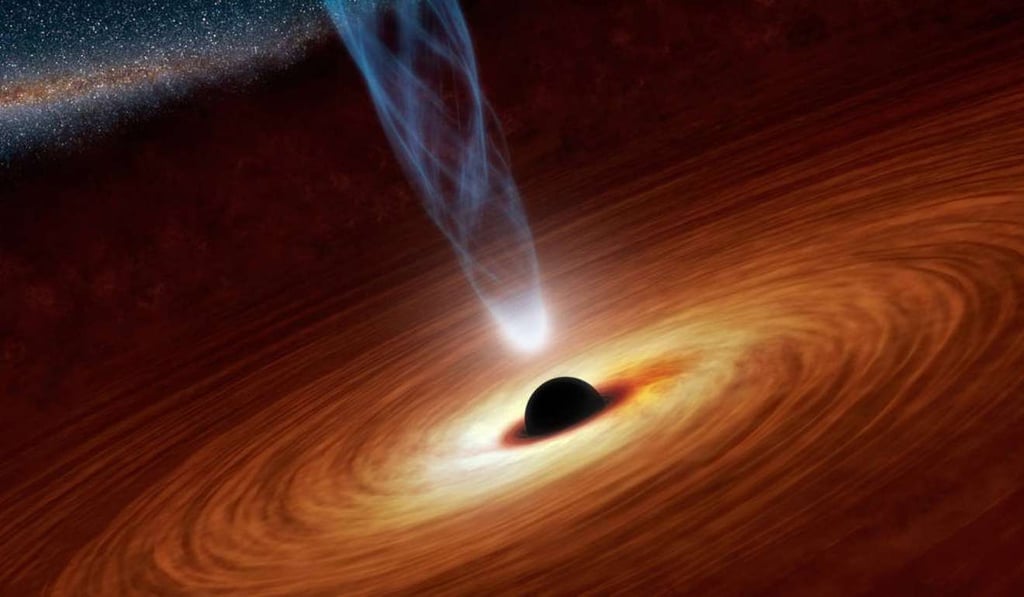
At least, no single telescope is. On Wednesday night, a battalion of 120 astronomers working at eight observatories on four continents began an unprecedented effort to image the black hole at the centre of the Milky Way, a body named Sagittarius A*. By combining observations from points across the globe, they’ll create a virtual observatory the size of Earth itself. The “Event Horizon Telescope,” they call it.
If all goes according to plan, the EHT should capture the dark silhouette of Sagittarius A* against the hot, glowing material that surrounds it, offering the first-ever glimpse at a black hole’s event horizon. The resulting snapshot could confirm our understanding of the laws of the universe - or upend it.
“It’s a very bold and gutsy experiment,” Stanford University theoretical astrophysicist Roger Blandford, who is not involved in the project, told Science last month. “It will validate this remarkable proposition: that black holes are common in the universe. Seeing is believing.”