Advertisement
Space
World

Scientists rejoice as telescopes capture ‘most spectacular fireworks in universe’, an epic collision that creates gold

‘We finally now know what happens when an unstoppable force meets an immovable object and it’s a kilonova’

4-MIN READ4-MIN
An artist's conception of a merger of two neutron stars, 130 million light years from Earth. Light from the ancient event finally reached Earth last month. Graphic: Robin Dienel, Carnegie Institution for Science.
Associated Press

It was a faint signal, but it told of one of the most violent acts in the universe, and it would soon reveal secrets of the cosmos, including how gold was created.

Astronomers around the world reacted to the signal quickly, focusing telescopes located on every continent and even in orbit to a distant spot in the sky.

What they witnessed in mid-August and revealed Monday was the long-ago collision of two neutron stars – a phenomenon California Institute of Technology’s David H. Reitze called “the most spectacular fireworks in the universe.”

Advertisement

“When these things collide, all hell breaks loose,” he said.
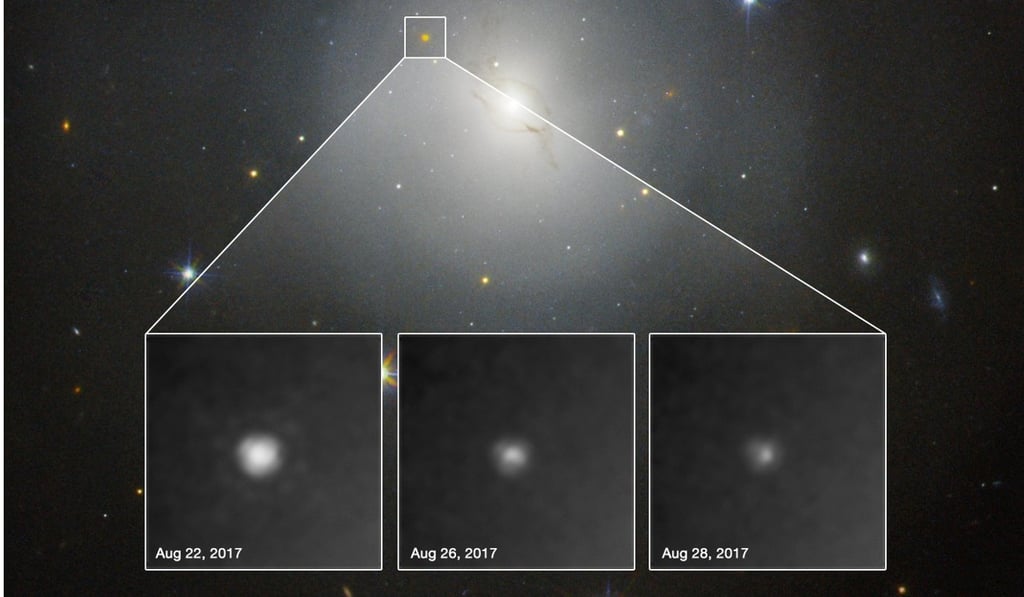
Measurements of the light and other energy emanating from the crash have helped scientists explain how planet-killing gamma ray bursts are born, how fast the universe is expanding, and where heavy elements like platinum and gold come from.
An undated handout image made available by the European Southern Observatory on Monday shows Hubble telescope images of a kilonova 130 million light years from Earth. The three inset photos were taken between August 22 and 28 and show the fading light from the collision between two neutron stars. Photo: EPA
We already knew that iron came from a stellar explosion, the calcium in your bones came from stars and now we know the gold in your wedding ring came from merging neutron stars
Ryan Foley, University of California Santa Cruz

“This is getting everything you wish for,” said Syracuse University physics professor Duncan Brown, one of more than 4,000 scientists involved in the blitz of science that the crash kicked off. “This is our fantasy observation.”

Advertisement
Select Voice
Select Speed
1.00x