Advertisement

Did that selfie make your nose look big? Science says yes, so there’s probably no need for plastic surgery

A selfie taken from 30cm away makes the nose look 30 per cent wider than a photo taken from 1.5 metres away, researchers found

Reading Time:2 minutes
Why you can trust SCMP
Indian teachers smeared with coloured powder take a selfie during Holi celebrations at a school in Ahmadabad on Thursday. Photo: Reuters

It is the inescapable 21st-century vexation of the vain. Smartphones allow a person to take selfies as fast as the index finger can click, yet from a dismayingly close distance that may leave the subject dissatisfied.

Don’t fret, researchers from Rutgers and Stanford universities say in a new analysis published Thursday. The culprit is distortion.

Using a mathematical model, the group found that in a selfie taken from 30cm away, the nose appears 30 per cent wider than in a photo taken from 1.5 metres.
Sports Illustrated Swimsuit models Raven Lyn, left, and Danielle Herrington, take a selfie before the SI Swimsuit Island news conference outside the W Hotel in Miami Beach on December 6, 2017. Photo: TNS
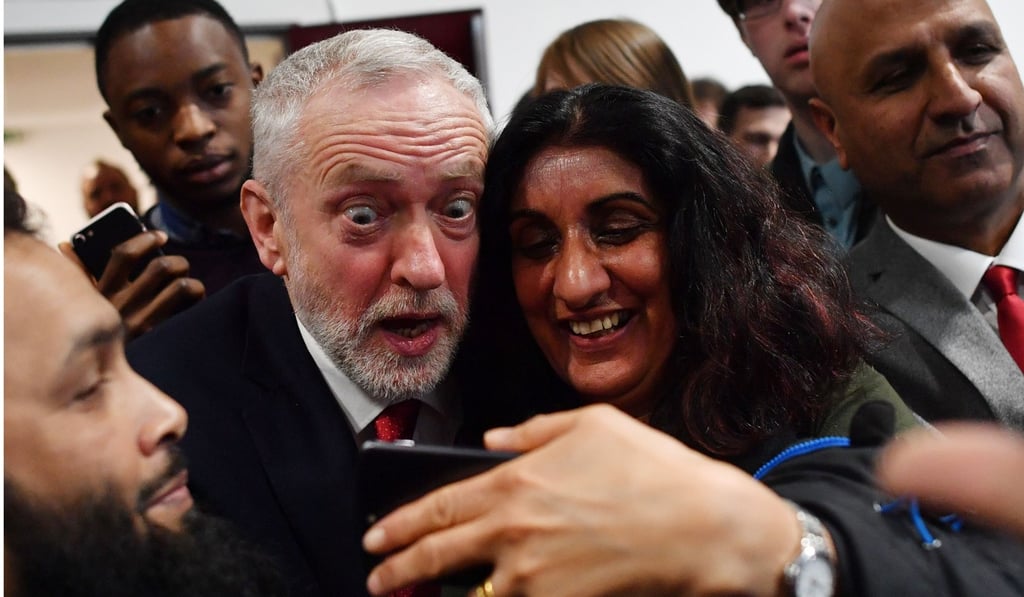
Bitish opposition Labour party leader Jeremy Corbyn poses for a selfie after giving a speech on Brexit at Coventry University in Coventry on Wednesday. Photo: AFP
Advertisement

The researchers undertook the analysis because plastic-surgery patients – who spent more than US$16 billion on cosmetic procedures in 2016, according to the American Society of Plastic Surgeons – often cited their appearance in selfies as justification for getting a nose job.

Boris Paskhover, an assistant professor at Rutgers New Jersey Medical School’s department of otolaryngology, wanted to set the record straight.

Advertisement
“Young adults are constantly taking selfies to post to social media and think those images are representative of how they really look, which can have an impact on their emotional state,” Paskhover said in a Rutgers news release. “I want them to realise that when they take a selfie, they are in essence looking into a portable funhouse mirror.”
A visitor takes a selfie with the Robot Assistant Pepper, from SoftBank Robotics, during the Mobile World Congress in Barcelona, Spain, on Wednesday. Photo: Reuters
Advertisement
Select Voice
Choose your listening speed
Get through articles 2x faster
1.25x
250 WPM
Slow
Average
Fast
1.25x