Advertisement

Rice, staple food of billions, could become less nutritious because of climate change

Increased levels of carbon dioxide cause serious reductions in vitamins and minerals in rice

Reading Time:3 minutes
Why you can trust SCMP
A farmer shows rice samples from a paddy field at the International Rice Research Institute (IRRI) in Laguna, south of Manila. Photo: Agence France-Presse

Human-caused greenhouse gas emissions threaten to make rice less nutritious, scientists said in a study released Wednesday, raising a worrying possibility about the staple food item for billions of humans.

Rice, the scientists found, contains lower levels of key vitamins when grown amid high concentrations of carbon dioxide, the most common of the greenhouse gases driving climate change.

“If we do nothing, then yes, there is this potential for profound negative impacts on human health,” said Kristie Ebi, a public health researcher at the University of Washington in Seattle and one of the authors of the study, which also involved researchers at institutions in China, Japan, Australia and the United States, including at the US Agriculture Department.
Lertviroj Kowattana, permanent secretary of the Thai Ministry of Agriculture and Co-operatives (C), dressed in a traditional costume, throws rice grains during the annual royal ploughing ceremony in central Bangkok on May 14. Photo: Reuters
Advertisement

The research, conducted in Japan and China, examined 18 rice varieties in outdoor experiments in which the plants were subjected to atmospheric carbon dioxide concentrations of 568 to 590 parts per million.

Current concentrations are about 410 parts per million, but they’re growing at about 2 parts per million every year – and could reach the study’s levels in the later part of this century.

Advertisement

Rice accounts for “approximately 25 per cent of all global calories,” according to the study, which was published in the journal Science Advances. It was led by Chunwu Zhu of the Chinese Academy of Sciences.
The study found that at the high concentrations, the crop’s content of the vitamins B1, B2, B5 and B9 all declined, including by as much as 30 per cent for B9 (folate). The research also confirmed previously discovered declines in protein, iron and zinc.
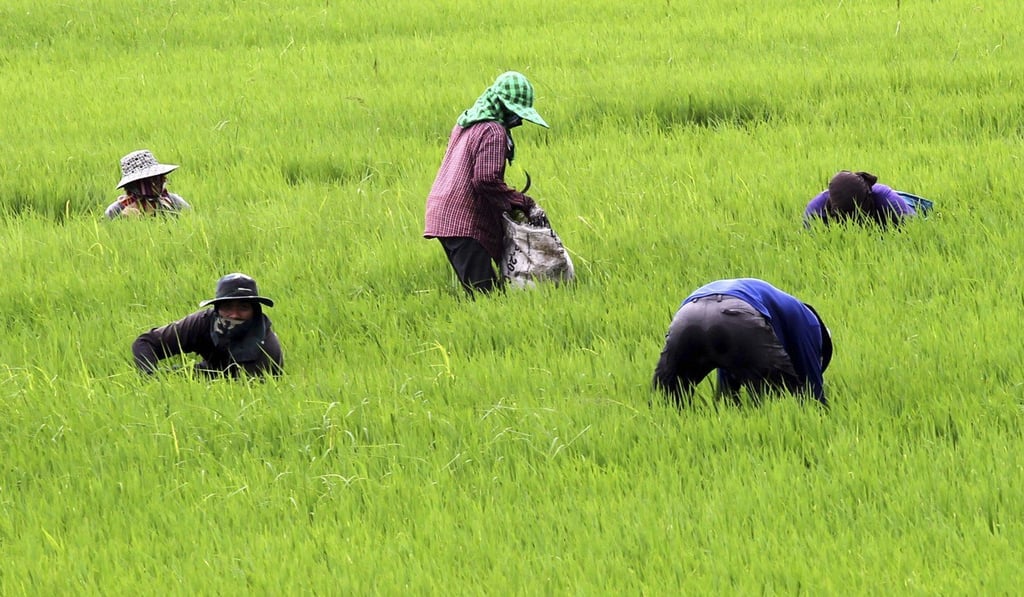
Farmers tend a rice field in Ayutthaya province, central Thailand. Photo: AP
Advertisement
Select Voice
Choose your listening speed
Get through articles 2x faster
1.25x
250 WPM
Slow
Average
Fast
1.25x