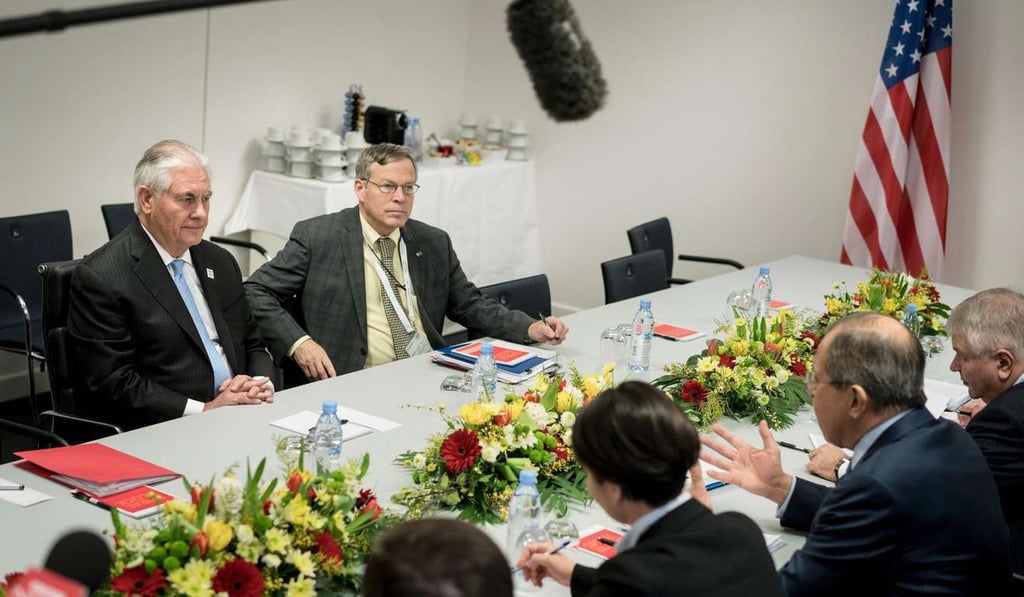
The Trump administration signalled Thursday there will be no change soon in US-Russian relations, putting the onus on Moscow to prove itself if it wants closer cooperation with Washington. Russia’s support for Ukrainian separatists was underscored as a test case of its willingness to change behaviour.
At a NATO meeting in Brussels, US Defence Secretary Jim Mattis made clear the United States isn’t ready to collaborate militarily with its former Cold War foe against the Islamic State or other threats, a long-standing goal of the Kremlin’s which new US President Donald Trump says he wants, too.
“Russia is going to have to prove itself first”
After meeting with Russia’s top diplomat in Germany, US Secretary of State Rex Tillerson said Moscow first must help stop violence in Ukraine.
The comments appeared to put the brakes on a rapid transformation in US-Russian ties, which have been badly strained by fighting in Ukraine and Syria as well as by American accusations of Russian interference in last year’s US presidential election. European countries close to Russia’s border have been especially alarmed by the prospects of US-Russian rapprochement, given Trump’s references to NATO as “obsolete” and his repeated praise for Russian President Vladimir Putin.
“Russia is going to have to prove itself first,” Mattis said. Nations will seek “a way forward where Russia, living up to its commitments, will return to a partnership of sorts here with NATO,” he explained.