Advertisement
Rodrigo Duterte
This Week in Asia

What now for Duterte’s China pivot as Marawi cements US importance for Philippines?

After being serially barked at, America is out of the doghouse, and

the strongman goes eerily silent

Reading Time:4 minutes
Why you can trust SCMP
Philippine President Rodrigo Duterte: silent, for once. Photo: AFP
Debasish Roy Chowdhury

What a difference a few months make.

It was only October when Rodrigo Duterte announced his “separation” from treaty partner United States after months of an increasingly acrimonious marriage. “America has lost now,” the Philippine president pronounced at the Great Hall of the People in Beijing. “I’ve realigned myself in your ideological flow and maybe I will also go to Russia to talk to [President Vladimir] Putin and tell him that there are three of us against the world – China, Philippines and Russia. It’s the only way.”
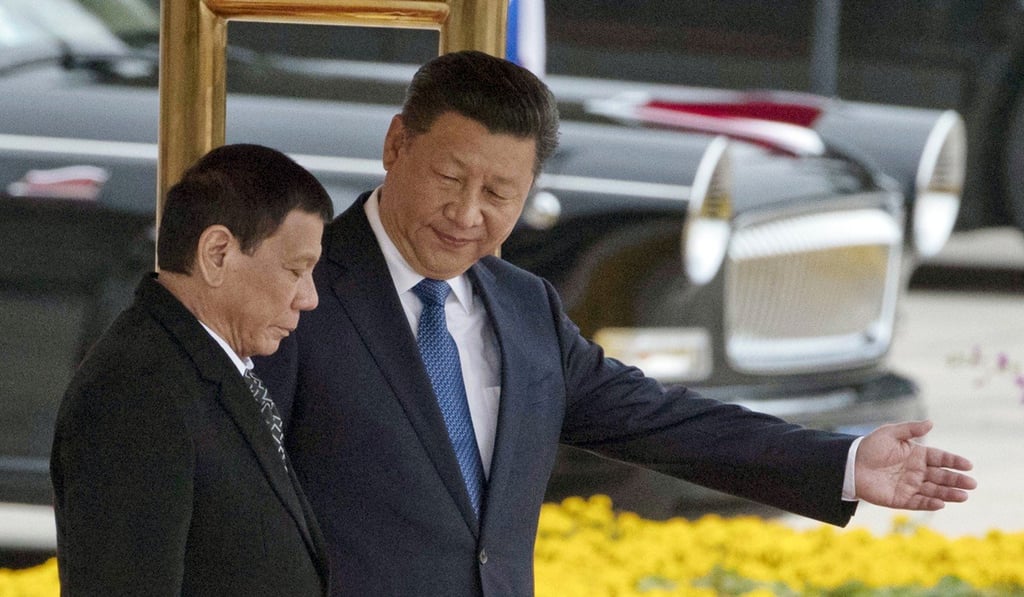
Philippine President Rodrigo Duterte with Chinese President Xi Jinping in October, when he announced Manila’s ‘separation’ from the United States. Photo: AP
Only the previous month, he declared, as grandly, that the US special forces stationed in insurgency-torn Mindanao would have to leave and Manila would review its policy of allowing American forces to combat terrorist groups in the Muslim-majority southern island.

There’s too much drug blood on America’s hands to lecture Duterte
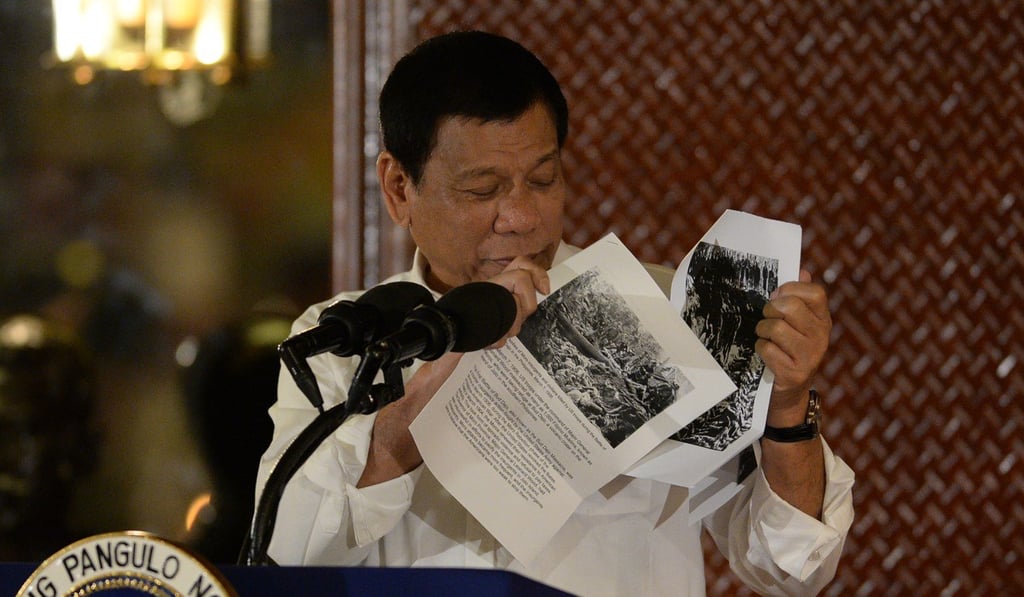
Cut to June. After three weeks of an armed conflict between government forces and Islamist rebels in Mindanao’s Marawi City, the government this week conceded the same US special forces were helping Filipino soldiers to free the hostages taken by Maute militants. The admission came after much hemming and hawing as the government kept dodging questions about US troops, till it was left with no choice when US sources spilled the beans.
Philippine President Rodrigo Duterte gives his speech in September in which he said he would review the policy of allowing American forces to combat terrorist groups in Mindanao. Photo: AFP
“At the request of the Philippines government, US special operations forces are assisting the Armed Forces of the Philippines with ongoing operations in Marawi through support that helps AFP commanders on the ground,” Emma Nagy, acting press attaché to the US Embassy in Manila confirmed to This Week in Asia.
Advertisement

To rub it in, the US let it be known it was also providing fresh military hardware to the Philippine forces. Before Marawi imploded, Duterte has been repeatedly threatening to reduce purchases of US weapons in favour of Russian and Chinese arms. Before leaving for his Russia trip last month – which he cut short as a result of the Marawi crisis – he had announced that one of his top asks from Putin would be Russian arms for Mindanao. His Russia trip came just a week after his second trip to Beijing in less than a year, during which he secured a US$500 million loan to buy Chinese weapons.

Advertisement
Philippine Marines Commandant Emmanuel Salamat tries a machine gun donated by the United States. Photo: AFP
Eating his words clearly isn’t agreeing with Duterte. Said to be “resting”, he hasn’t been seen or heard since being forced to admit the US role last Sunday, raising questions about his health. “He’s had to swallow his pride,” said Jaime Naval, an assistant professor at the University of Philippines Diliman. “He now says he did not ask for American help, the ground commander did. I find it very hard to believe a decision as important as this would be made at that level, especially after all the anti-American talk from the president.”

Since taking power in June, the Philippine strongman has tried to build bridges with a rising China by setting aside a territorial dispute in the South China Sea and has sought to ease his country’s strategic dependence on the US. Rejecting American military help, including scaling down the number and scope of military exercises and patrols with the US, has been central to the self-styled socialist leader’s “independent” foreign policy.

Advertisement
Select Voice
Choose your listening speed
Get through articles 2x faster
1.25x
250 WPM
Slow
Average
Fast
1.25x