-
Advertisement
China's leadership reshuffle 2017
This Week in AsiaOpinion
Cary Huang

Sino File | Opinion: Can Asia handle parallel rise of strongmen in Japan and China?

The Chinese and Japanese leaders both won major political victories this week – and their strengthened grips on power will only embolden their aggressive agendas

Reading Time:3 minutes
Why you can trust SCMP
Japanese Prime Minister Shinzo Abe shakes hands with China’s President Xi Jinping. Photo: AFP

STRONGMAN POLITICS have made a comeback in Asia with the leaders of the two biggest economies in the region granted even more power.

President Xi Jinping, China’s most influential leader in decades, emerged from the five-yearly party congress on Tuesday with an even tighter grip on the nation after being elevated to almost godlike status, equalling the late communist founder Mao Zedong.
Meanwhile, Japanese Prime Minister Shinzo Abe’s mandate was strengthened after his Liberal Democratic Party coalition won a landslide victory in a snap election on Sunday. With a two-thirds supermajority in the Diet, the parliament, Abe is able to hold on to office for a third term, putting him on track to become Japan’s most influential and longest-serving leader since the end of the second world war.

Analysis: What China's leadership reshuffle means for Xi Jinping's new era

But their political triumphs do not help heal frayed ties. Instead, they cast a further shadow over future relations between the world’s second and third largest economies. Their victories show that chauvinistic patriotism and entrenched hegemonic competition have continued to run high under Xi and Abe’s stewardship, over the past five years.
Advertisement
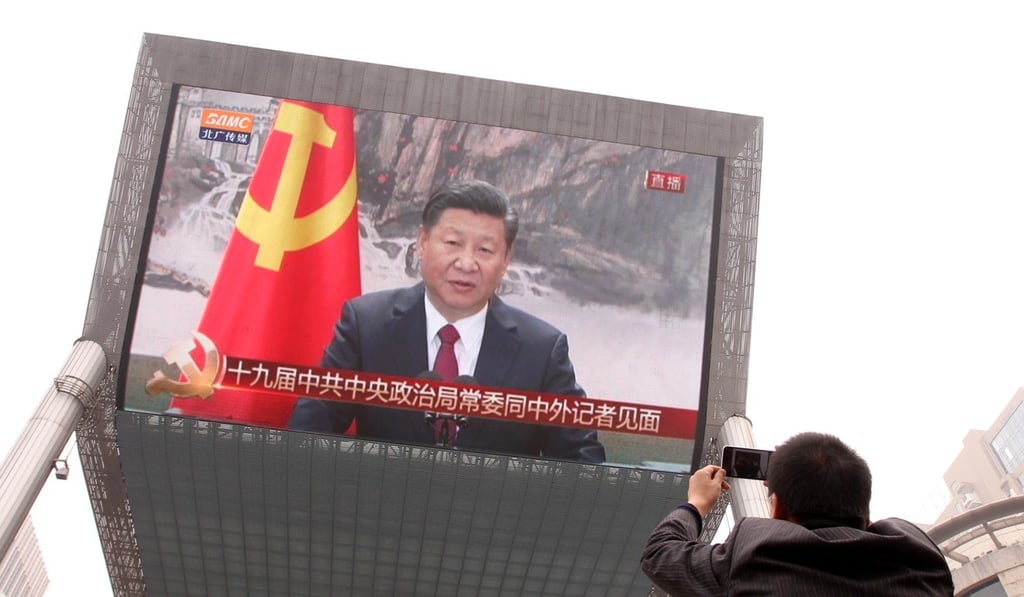
A live broadcast in Beijing of Chinese President Xi Jinping addressing members of the Politburo Standing Committee during the Communist Party’s 19th congress. Photo: SCMP

Both are known for being their countries’ toughest leaders in generations. Since rising to power in 2012, Xi and Abe have been locked in a spiralling diplomatic stand-off, causing Sino-Japanese relations to plunge to their lowest levels since diplomatic ties were established in 1972 – a comparatively friendlier and more harmonious time.
Advertisement
Fears of a military clash have intensified in recent years, with both nations deploying warships and fighter jets in the vicinity of the contested Diaoyu Islands – known in Japan as the Senkakus – in the East China Sea. Both countries’ leaders are known for hawkish stances on issues concerning each others’ core interests: be it on the North Korean nuclear crisis, war history, freedom of navigation in the South China Sea, or simply competing for regional and global influence.
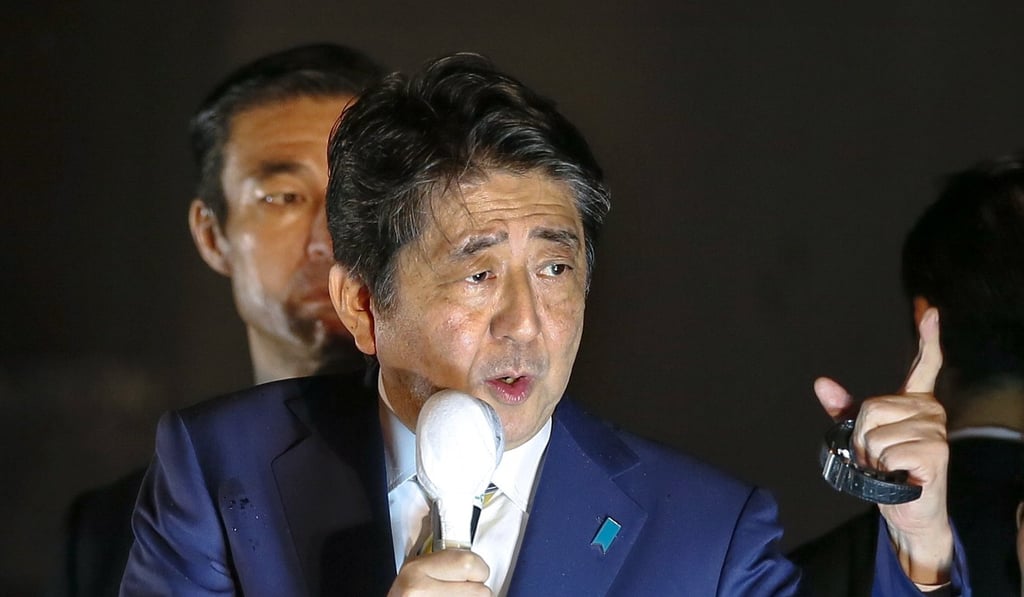
Japanese Prime Minister Shinzo Abe won convincingly in Sunday’s snap election, giving him the chance to rule for a third term. Photo: EPA
While having emerged through very different systems – one a democracy and the other a one-party state – Xi and Abe bear striking parallels in their backgrounds, personalities and political outlooks.
Advertisement
Select Voice
Select Speed
1.00x