
Back To The Future | Who would win: Chinese broadsword vs Japanese bayonet? Police academy has the answer
After a victory for mixed martial arts over tai chi, This Week in Asia settles another long-running combat rivalry

The martial arts world was recently set abuzz when MMA fighter Xu Xiaodong defeated tai chi master Wei Lei in a one-sided, 10-second bout in Chengdu, China. Some believe the victory proves Xu’s claim that traditional martial arts are outdated; others question whether Wei was fit to represent his sport. Either way, with a host of martial arts experts now lining up to fight Xu, the debate over the merits of various fighting styles looks set to rage on. Here, Chow Chung-yan weighs up another long-running combat rivalry - this one with its roots in the second world war
WATCH: Viral video of tai chi master’s defeat by MMA fighter sparks kung fu debate
It is common for a country at war to hype up a certain weapon to motivate its people. In China during the second world war, the weapon that most captured the public’s imagination was the Chinese dadao (broadsword).
The war was brutally one-sided. Against Japanese imperial troops armed with bombers and tanks, most Chinese soldiers had only a simple rifle. Not only were the Japanese much better equipped, their soldiers were professionally trained. All Japanese soldiers had to go through intense training in jukendo – fighting with a bayonet.
Jukendo was a combat technique borrowed from the West and combined with traditional Japanese spear fighting moves. In battles, the Japanese applied it with deadly effect.
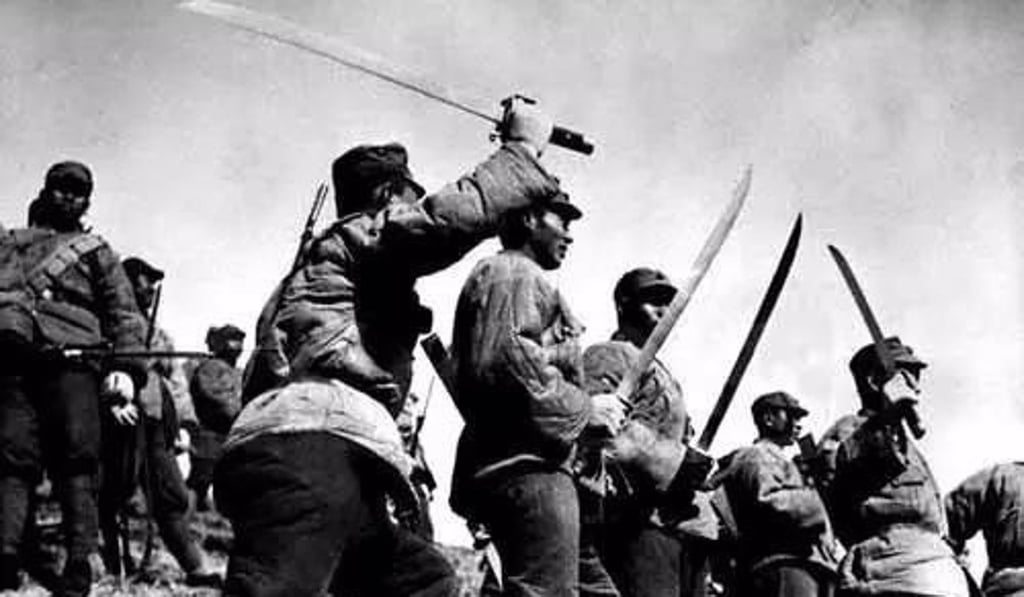
While the Chinese enjoyed a numerical advantage, their soldiers were mostly peasants who had little martial training. Not only were Chinese soldiers outgunned by the Japanese, they were often outfought in melees as well.
In March 1933, a Chinese squad armed with the traditional broadsword carried out a daring sortie under the cover of night against Japanese troops occupying a section of the Great Wall. They won the close-quarter battle, but it was costly. The news greatly cheered the Chinese public.