Advertisement
Business of climate change
Business

Climate scientists cover Sichuan’s Dagu glaciers with Tencent-sponsored hi-tech blanket to impede their melt amid global warming

  • About 8,000 glaciers, or 15 per cent of the total in China, have melted in the past 50 years due to global warming
  • Half of the Earth’s 215,000 glaciers could disappear entirely by 2100, with ramifications for the world’s supply of fresh water and ecosystems

Reading Time:3 minutes
Why you can trust SCMP
5
Researchers at Nanjing University cover the glacier with self-developed radiative cooling film to preserve the snow at Dagu Glacier on June 30, 2023. Photo: Handout
Yujie Xuein Shenzhen

A giant blanket has gone up over a portion of China’s most accessible glacier to slow its melting, as climate scientists race to stem their retreat amid global warming.

At the Dagu glaciers in the Tibetan region of southwestern China’s Sichuan province, thick rolls of white sheets now cover an area of over 400 square metres. Supported by poles and anchored with wooden boards, the sheets feature a newly developed film that achieves radiative cooling, which scientists hope can slow down the melting rate of Dagu’s glaciers.

“Our material is lighter in texture, water-repellent, more eco-friendly, and can be reused multiple times,” said the Nanjing University’s associate professor Zhu Bin, during a visit two weeks ago to the area. “The cost of it is also on par with traditional geotextiles.”

05:01

Chinese scientists try to stop glaciers from melting with innovative thermal blanket

Chinese scientists try to stop glaciers from melting with innovative thermal blanket
Zhu leads a team supported by the university’s three-year partnership with the Tencent Carbon Neutral Lab, a unit set up in 2021 by the world’s biggest video games publisher Tencent Holdings.
Zhu Bin, associate professor of Nanjing University at Dagu Glacier on June 28, 2023. Photo: Thomas Yau
The team is racing against time to slow down the melting of glaciers, fighting a losing game to retard, if not entirely stop the process. Floods that burst out from glacial lakes when glaciers melt threaten 15 million people around the world, putting 1 million at risk in western China’s Xinjiang, Tibet, Qinghai, Sichuan and Yunnan regions, according to a study.
Advertisement

About 8,000 glaciers, or 15 per cent of the total in China, have melted in the past 50 years due to global warming, according to calculations by Kang Shichang, the director of the State Key Laboratory of Cryosphere Sciences at the Chinese Academy of Sciences, the country’s national science think tank.

Half of the Earth’s 215,000 glaciers could disappear entirely by 2100 – with ramifications for the world’s supply of fresh water and ecosystems – even if humanity can successfully curb global warming to 1.5 degrees Celsius, according to research published in the Science journal in January.
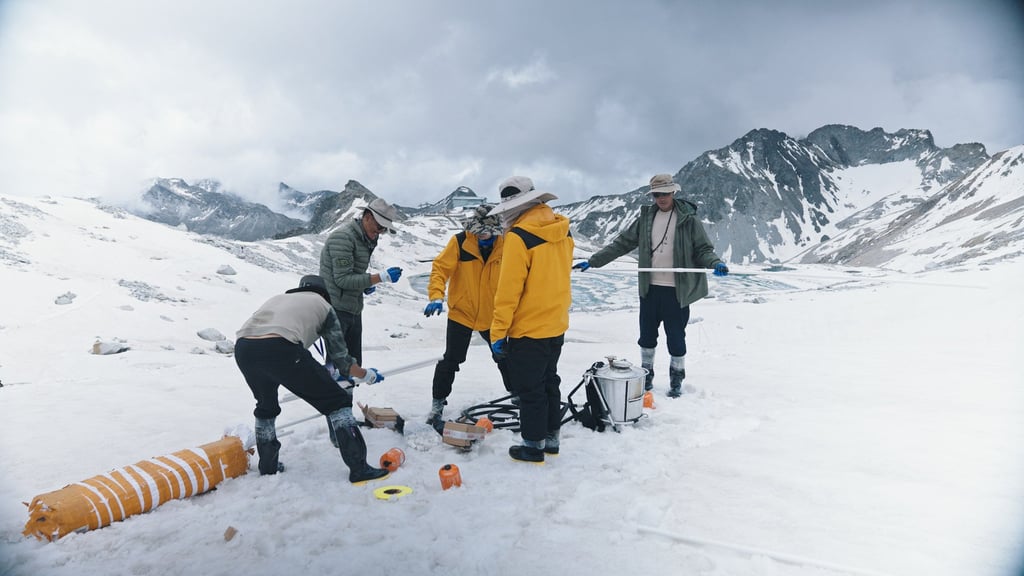
Researchers at Nanjing University cover the glacier with self-developed radiative cooling film to preserve the snow at Dagu Glacier on June 30, 2023. Photo: Handout
Although China has committed to reduce greenhouse-gas emissions to reach carbon neutrality by 2060, the country’s meteorological administration announced last month that the El Niño climate phenomenon is expected to bring more extreme weather, including record high temperatures, to China.
Advertisement
Advertisement
Select Voice
Choose your listening speed
Get through articles 2x faster
1.25x
250 WPM
Slow
Average
Fast
1.25x