Advertisement
China stock market
BusinessBanking & Finance

Global fund managers build ‘significant exposure’ to Chinese stocks in sentiment shift, HSBC says

  • Global emerging-markets funds have dialled back their underweight positions and turned neutral on China’s yuan-traded stock
  • Asian funds, those with mandates to invest in the region excluding Japan and Australia, have significantly raised mainland China allocations to a seven-month high

Reading Time:2 minutes
Why you can trust SCMP
9
A man stands in front of an electronic stock board in the stock market of Shanghai. Photo: Reuters
Zhang Shidongin Shanghai

Global investors have turned more constructive on Chinese stocks and “have built significant exposure to mainland equities”, investment bank HSBC said in a report after a flurry of steps taken by the regulator sparked a 10 per cent rebound from a February low in China’s CSI 300 Index, a benchmark comprising 300 of the largest companies listed on the Shanghai and Shenzhen stock exchanges.

“GEM [global emerging markets] funds have rolled back on their underweight [position] on mainland China and turned neutral, while Asia’s funds exposure on the market is now at a seven-month high,” said the bank’s team of strategists led by Herald van der Linde in a report published on Thursday. “This has come at the cost of a significant cut in allocation in Taiwan.”
The report adds further evidence that foreign investors are returning to China’s US$9 trillion stock market after a record exodus spurred by a faltering growth outlook, elevated US interest rate and the overhang of geopolitical tensions. UBS Group this week upgraded its rating on Chinese stocks to overweight, citing earnings resilience at big companies, while Goldman Sachs sees an upside of up to 40 per cent in stock prices after the State Council issued guidelines seeking to reshape the capital market.
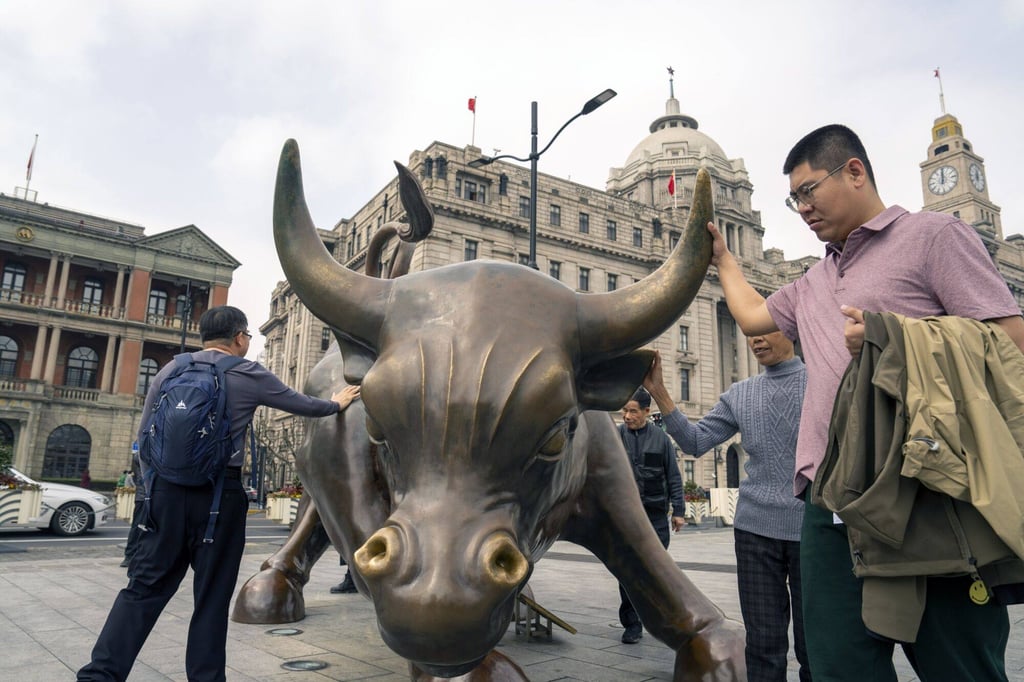
Pedestrians touch the Bund Bull in Shanghai, China, on Monday, Feb. 19, 2024. Photo: Bloomberg
The regulatory changes, which have arrested a three-year market downturn, culminated this month, when the cabinet issued a document, in a rare move to urge reforms of the stock market by strengthening scrutiny and boosting returns to shareholders. Earlier, Beijing had directly intervened, buying stocks through state-owned funds or the so-called national team. It also replaced the head of the stock-market watchdog as part of the rescue package.
Advertisement
Overseas investors bought a combined 22 billion yuan (US$3.04 billion) of Chinese stocks in the second consecutive month of net buying in March via the exchange link programme with Hong Kong, snapping a record six-month outflow streak through January.

While sentiment has improved, fundamentals remain as a key concern for global investors. Both retail sales and industrial production trailed the consensus projections last month and the downturn on the property market, which roughly made up about a quarter of China economy, continued. This led some economists including those at Nomura Holdings to warn that growth may have peaked in the first quarter of the year.

Advertisement
Advertisement
Select Voice
Choose your listening speed
Get through articles 2x faster
1.25x
250 WPM
Slow
Average
Fast
1.25x