Hong Kong investors at a disadvantage when firms with assets in China go bankrupt
The 'one country, two systems' principle puts Hong Kong receivers at a disadvantage when dealing with assets held on the mainland

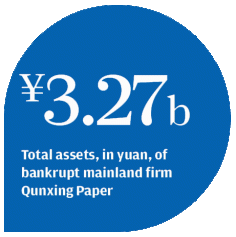
The HK$4.1 billion bankruptcy proceedings involving a mainland subsidiary of Hong Kong-listed decorative paper maker Qunxing Paper highlight the risks to investors of acquiring exposure to firms that have the bulk of their assets outside the city.
The proportion is likely to increase further with a wave of asset injections by Chinese state-owned enterprises following in the footsteps of Beijing conglomerate Citic Group, which said last week it would inject its entire business into Citic Pacific, its Hong Kong-listed subsidiary.
"This is worrying, since many mainland companies have their assets located in mainland China," said veteran liquidator Derek Lai, the Asia-Pacific leader of restructuring services at Deloitte Touche Tohmatsu, who has handled many bankruptcies of Hong Kong-listed mainland companies.
"If they go bankrupt, the 'one country, two systems' principle means Hong Kong receivers and liquidators cannot freely handle the assets on the mainland, [the disposition of which depends] on the decisions of mainland courts, which may be more favourable to mainland creditors and employees.
"This has made it hard to retrieve assets for offshore creditors and shareholders."