Advertisement
Electric & new energy vehicles
BusinessChina Business

Shanghai Auto Show 2021: China’s Evergrande NEV, valued at US$87 billion, has not sold a single electric car

  • Shareholders have pushed Evergrande NEV’s Hong Kong-listed stock up more than 1,000 per cent over the past 12 months
  • The electric car maker, which has not sold a single vehicle, is valued at US$87 billion, more than Ford Motor and General Motors

Reading Time:7 minutes
Why you can trust SCMP
3
A view of the production line. Evergrande Group said it has put its first-ever electric vehicle, the Nevs 93, into production.  (courtesy of Evergrande Group)
Bloomberg

China Evergrande New Energy Vehicle Group’s expansive pop-up showroom sits at the heart of Shanghai’s National Exhibition and Convention Center. With nine models on display, it’s hard to miss. The electric car upstart has one of the biggest booths at China’s 2021 Auto Show, which starts Monday, opposite storied German carmaker BMW. Yet its bold presence belies an uncomfortable truth – Evergrande hasn’t sold a single car under its own brand.

China’s largest property developer has an array of investments outside real estate, from soccer clubs to retirement villages. But it’s the recent entry into electric cars that’s captured investors’ imaginations. Shareholders have pushed Evergrande NEV’s Hong Kong-listed stock up more than 1,000 per cent over the past 12 months, allowing it to raise billions of dollars in fresh capital. It now has a market value of US$87 billion, greater than Ford Motor and General Motors.
Such exuberance over an carmaker that has repeatedly pushed back forecasts for when it will mass produce a car is emblematic of the froth that has been building in EVs over the past year, with investors ploughing money into a rally that briefly made Elon Musk the world’s richest person and has some concerned about a bubble. Perhaps nowhere is that more evident than in China, home to the world’s biggest market for new energy cars, where a mind-boggling 400 EV manufacturers now jostle for consumers’ attention, led by a cabal of start-ups valued more than established auto players but which have yet to turn a profit.
Advertisement
Evergrande NEV was a relatively late entrant to that scene. In March 2019, Hui Ka-yan, Evergrande’s chairman and one of China’s richest men, vowed to take on Musk and become the world’s biggest maker of EVs in three to five years. Tesla’s Model Y crossover had just had its global debut. In the two years since, Tesla has gained an enviable foothold in China, establishing its first factory outside the US and delivering around 35,500 cars in March. Chinese rival NIO earlier this month reached a significant milestone when its 100,000th EV rolled off the production line, prompting Musk to tweet his congratulations.
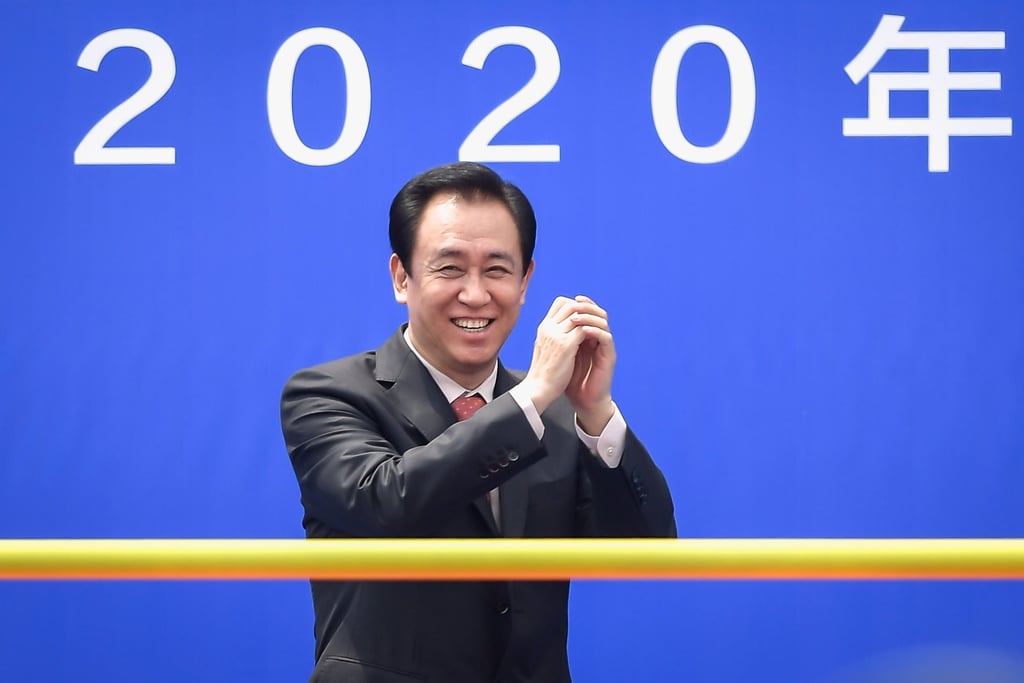
Chinese billionaire businessman and chairman of Evergrande Group Xu Jiayin, or Hui Ka Yan in Cantonese, attends the opening ceremony of the new home court of Guangzhou Evergrande Taobao of Chinese Football League in Guangzhou on 16 April 2020.

Despite his lofty ambitions and Evergrande NEV’s rich valuation, Hui has repeatedly pushed back car-production targets. The tycoon’s coterie of rich friends, among others, have stumped up billions, but making cars – electric or otherwise – is hard, and hugely capital intensive. NIO’s gross margins only flipped into positive territory in mid-2020, after years of heavy losses and a lifeline from a municipal government.

Advertisement
Advertisement
Select Voice
Choose your listening speed
Get through articles 2x faster
1.25x
250 WPM
Slow
Average
Fast
1.25x