-
Advertisement
A-shares
BusinessChina Business

Global stocks slump to bear market for the first time since March 2020 as key MSCI index falls 21 per cent from its November record

  • The MSCI All-Country World Index has fallen 21 per cent from its all-time high in November, technically entering a bear market
  • Fears of faster policy tightening by the Fed to tame inflation heighten while China’s zero-Covid policy adds to global slowdown concern

Reading Time:3 minutes
Why you can trust SCMP
2
Pedestrians in front of an electronic quotation board displaying the numbers of the world’s stock market in Tokyo on June 14, 2022. Photo: AFP.
Zhang Shidong

The world’s stock market slipped into bear-market territory for the first time in more than two years amid concerns that rising interest rates and a persistent Covid-19 pandemic may tip some major economies into recession.

The MSCI All-Country World Index, a benchmark gauge that tracks about 2,900 stocks in developed and emerging markets, dropped 3.7 per cent to 597.64 on Monday. More than US$18 trillion was erased in the 21-per cent slump from the index’s November 16 high, the textbook definition of a bear market.
Global equities are in the second peak-to-trough plunge exceeding 20 per cent since March 2020, as the Covid-19 pandemic remains entrenched in many regions, with resurgent waves in mainland China, Hong Kong and Taiwan. At the same time, central banks led by the US Federal Reserve had raised the cost of money to stem the inflationary pressure unleashed by a decade of zero interest rates.
Advertisement
The Fed raised its benchmark borrowing costs by 50 basis points on May 4, the most since 2000, to tame the fastest inflation in four decades. Another of the central bank’s bimonthly Federal Open Market Committee (FOMC) meetings is scheduled on June 16, when it is likely to raise its benchmark rate again, part of the 10-step increase through the end of 2023 expected by economists.
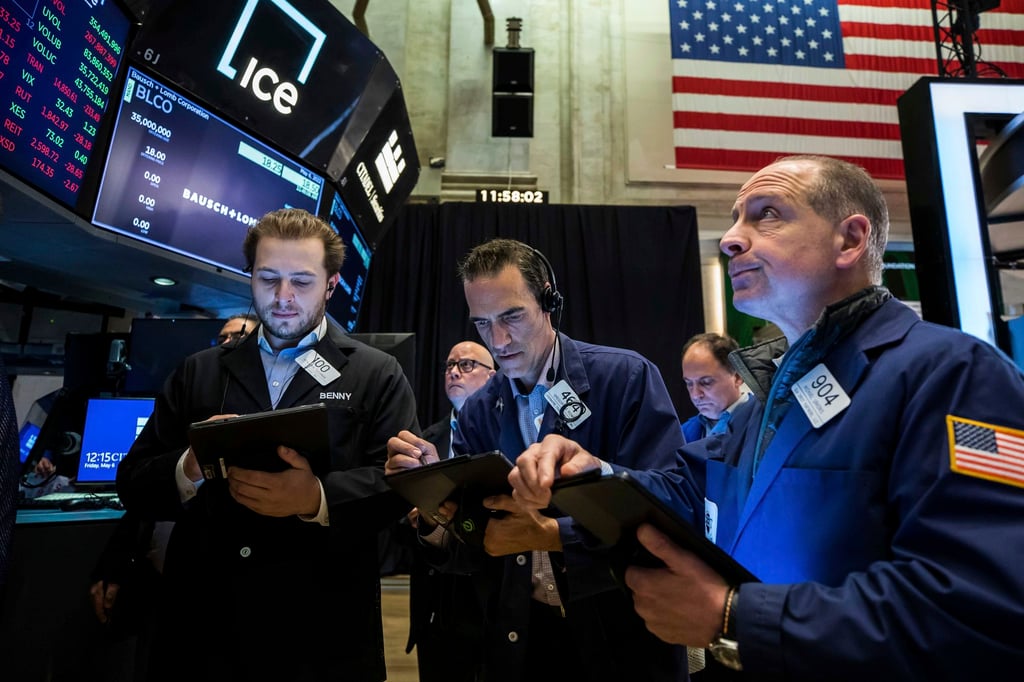
Traders work on the floor at the New York Stock Exchange on May 6 amid worries the Federal Reserve may cause a recession in its drive to stem inflation. Photo: NYSE via AP

“The Fed has the greenlight to tighten as much as possible to get inflation under control,” said Edward Moya, a senior analyst at Oanda. “Inflation will remain sticky and lead to sharply weaker purchasing power and consumption over the coming quarters, and that supports the idea the Fed will be able to move forward with more aggressive rate hikes over the next few meetings.”

Advertisement
Advertisement
Select Voice
Select Speed
1.00x