
Shanghai Auto Show: China’s underachieving EV start-ups skip premier event as they fade into oblivion
- At least six promising start-ups – WM Motor, Evergrande New Energy Auto, Qiantu Motor, Aiways, Enovate Motors and Niutron – did not take part in the show
- Of the 500 or so EV start-ups launched over the past decade, only around 200 have received certification from Beijing to mass produce cars
At least six companies – WM Motor, Evergrande New Energy Auto, Qiantu Motor, Aiways, Enovate Motors and Niutron – skipped the 10-day marquee event that started on Tuesday, missing a golden opportunity to build their image at the nation’s biggest car show.
These carmakers either have closed their factories or stopped taking new orders as a bruising price war takes a toll in the world’s largest automotive and EV market.
“Overcapacity is emerging as a big issue in the EV industry,” said Cao Hua, a partner at private-equity firm Unity Asset Management, who visited the show on Thursday. “The auto exhibition provides a vivid snapshot of the market. Small and underachieving players will not be able to survive the cutthroat competition.”
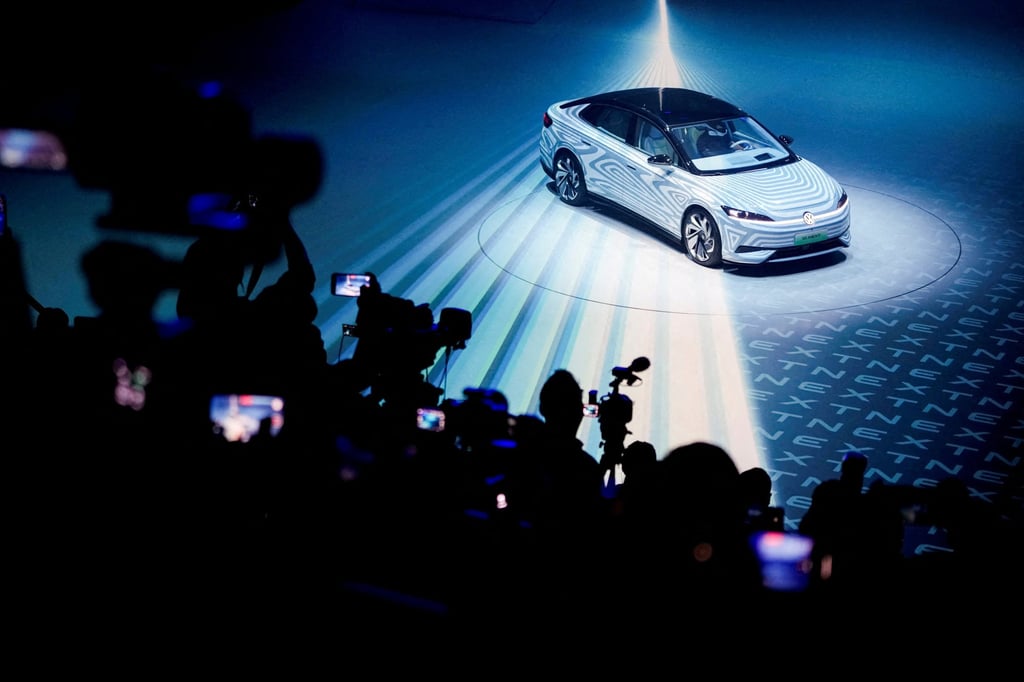
Over the past 10 years as many as 500 EV start-ups mushroomed in China, hoping to grab a share of the fast-growing market and take advantage of the government’s tax breaks and cash subsidies to encourage the use of the environment-friendly cars.
Currently, only about 200 EV companies are certified by Beijing to mass produce electric cars, which include conventional carmakers like SAIC Motor and start-ups such as Nio and Xpeng.
BYD’s crab-walking U8 draws large crowds at Shanghai Auto Show
The Shanghai Auto Show, one of the largest industry exhibitions in the world, has attracted nearly 1,000 assemblers and car component makers. More than 100 new models, including 70 EVs, will make their global premiere at the show, while 1 million visitors are expected until April 27.
The last show in 2021 was held under strict virus control measures when only a few key overseas industry executives attended it due to China’s stringent travel restrictions.
Tesla, the runaway front-runner in the mainland’s premium EV segment, also skipped the fair this year, without giving reasons for its absence.
“Industry officials and consumers once pinned much hope on the six companies after they spent billions of dollars to develop battery-powered vehicles,” said Chen Jinzhu, CEO of consultancy Shanghai Mingliang Auto Service. “The market conditions now make it almost impossible for any of them to access fresh funds and stage a comeback.”

Young Chinese drivers are increasingly keen on digital and autonomous driving technologies adopted by EVs in a fast-growing market where research and development investment for a new production model could amount to 40 billion yuan (US$5.8 billion), according to William Li, CEO of Nio.
On Thursday, BMW was accused of discriminating against Chinese visitors at the show amid claims that staff at its Mini booth favoured foreign visitors during an ice-cream giveaway promotion.
Mini apologised for the incident, saying in a statement on its official Weibo account that it was caused by poor internal management and that it would improve training.

