Advertisement
China stock market
BusinessChina Business

China’s stocks underperform the region after US raises import tariffs on a range of Chinese goods

  • US-China tensions spiked after the Washington moved to increase levies on a range of Chinese imports, triggering a pledge from Beijing it would take necessary action
  • Nomura says ‘concerned China may face similar trade-restrictive measures from other regions’ after criticism from its major trade partners

Reading Time:2 minutes
Why you can trust SCMP
Chinese Commerce Minister Wang Wentao. The Ministry of Commerce said the proposed tariff hikes violate President Joe Biden’s commitments to avoid decoupling from China and “not to seek to suppress and contain China’s development”   Photo: China Ministry of Commerce
Zhang Shidongin Shanghai
China’s stocks fell amid resurgent trade tensions after the US administration increased import tariffs on a range of Chinese products, with Beijing saying that it would take “full necessary measures to safeguard its legitimate rights and interests”.

The Shanghai Composite Index slipped 0.8 per cent to 3,119.90 at the close. The CSI 300 Index retreated 0.9 per cent, while the Shenzhen Composite Index slid 0.8 per cent.

Mainland China underperformed other major Asian markets that rallied ahead of a US inflation report that could press the case for an interest-rate cut by the US Federal Reserve in September. Japan’s Nikkei 225 climbed 0.1 per cent, while Australia’s S&P/ASX 200 added 0.4 per cent and Taiwan’s Taiex index advanced 0.8 per cent. Hong Kong’s stock markets were shut for a public holiday and will resume trading on Thursday.
Advertisement
Tensions between the world’s two largest economies re-escalated after Beijing slammed Washington’s move to increase levies, vowing to take necessary action to protect the interests of Chinese companies. US President Joe Biden blamed China for subsidising these industries that have inundated the global market with unfairly cheap products and excessive capacity.
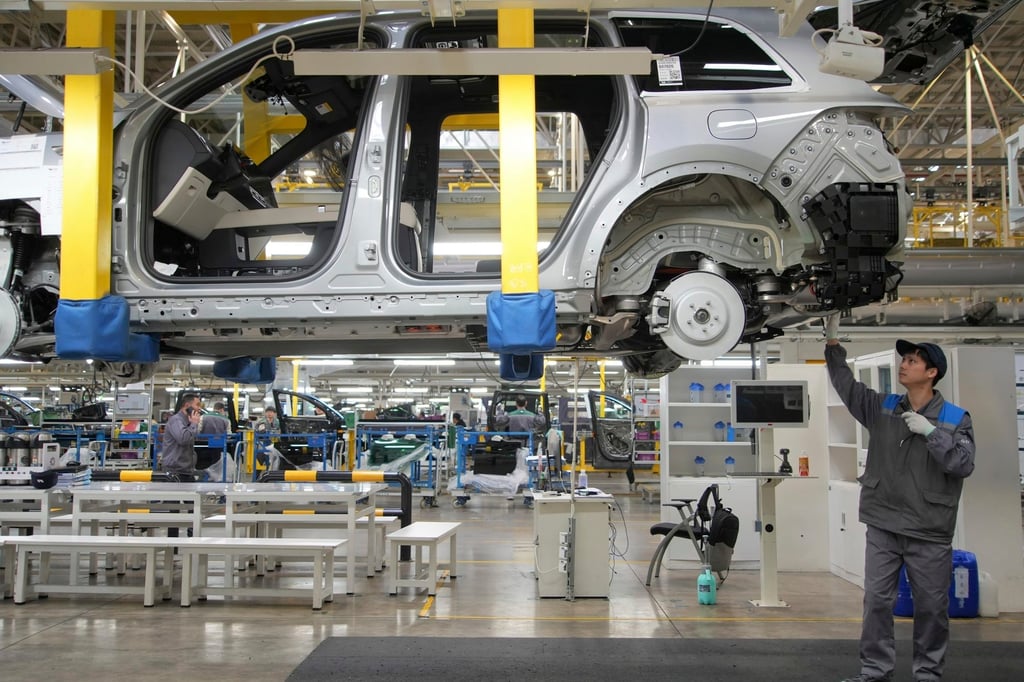
A worker assembles an SUV at a car plant of Li Auto, a major Chinese EV maker, in Changzhou in eastern China’s Jiangsu province on March 27, 2024. The Biden administration has announced plans to slap new tariffs on Chinese electric vehicles, advanced batteries, solar cells, steel, aluminium and medical equipment. Photo: AP

Japanese investment bank Nomura said while the higher tariffs would affect US$18 billion worth of Chinese products and less than 1 per cent of China’s total overseas shipments, the larger concerns were with consequences of the ripple effect.

Advertisement
Advertisement
Select Voice
Choose your listening speed
Get through articles 2x faster
1.25x
250 WPM
Slow
Average
Fast
1.25x