-
Advertisement
Hong Kong stock market
BusinessChina Business

Hong Kong stocks post fourth straight week of gains driven by upbeat earnings, China policy support

  • Property stocks rally after Beijing moved to allow governments to buy certain flats, relaxed mortgage rules and pledged to deliver unfinished homes
  • Patchy economic data has triggered hopes it may also push policymakers to take stronger actions to boost domestic demand

Reading Time:2 minutes
Why you can trust SCMP
General view of Hong Kong Exchange Square in Central. Photo:  Jelly Tse.
Zhang Shidongin Shanghai
Hong Kong stocks rose on Friday, helping the benchmark index to its fourth straight week of gains, as results from Baidu and JD.com suggested corporate earnings may have bottomed out and Beijing delivered a batch of property support measures.

The Hang Seng Index climbed 0.9 per cent to 19,553.61 at the close, taking the week’s gain to 3.1 per cent. This is the fourth weekly gain, the longest stretch of such advances registered since January 2023. The Hang Seng Tech Index added 1 per cent and the Shanghai Composite Index also advanced by an equal amount.

Baidu rallied 2.3 per cent to HK$110.90 and e-commerce giant JD.com gained 1.3 per cent to HK$134.10 after the two companies reported first-quarter results that exceeded the consensus estimates. Alibaba Group Holding surged 7.5 per cent to HK$85.70, rebounding from a slump spurred by weak earnings.
Advertisement
Property stocks were in focus as Vice-Premier He Lifeng called on local governments to purchase idle land and unsold homes from developers and the central bank eased the rules on mortgage loans in the most forceful measures to shore up the property market. Longfor Group Holdings surged 11 per cent to HK$15.30 and China Overseas Land and Development jumped 4.4 per cent to HK$16.52.

“The government does not need to purchase all unsold homes to bring the market closer into balance,” said Julian Evans-Pritchard, head of China Economics at Capital Economics. “It simply needs to bring the inventory to sales ratio, which is at its highest level since at least 2016, back down to normal levels.” He estimated this would require the government to purchase a third of all unsold homes, which would need 3 trillion yuan (US$415.3 billion) in funding.
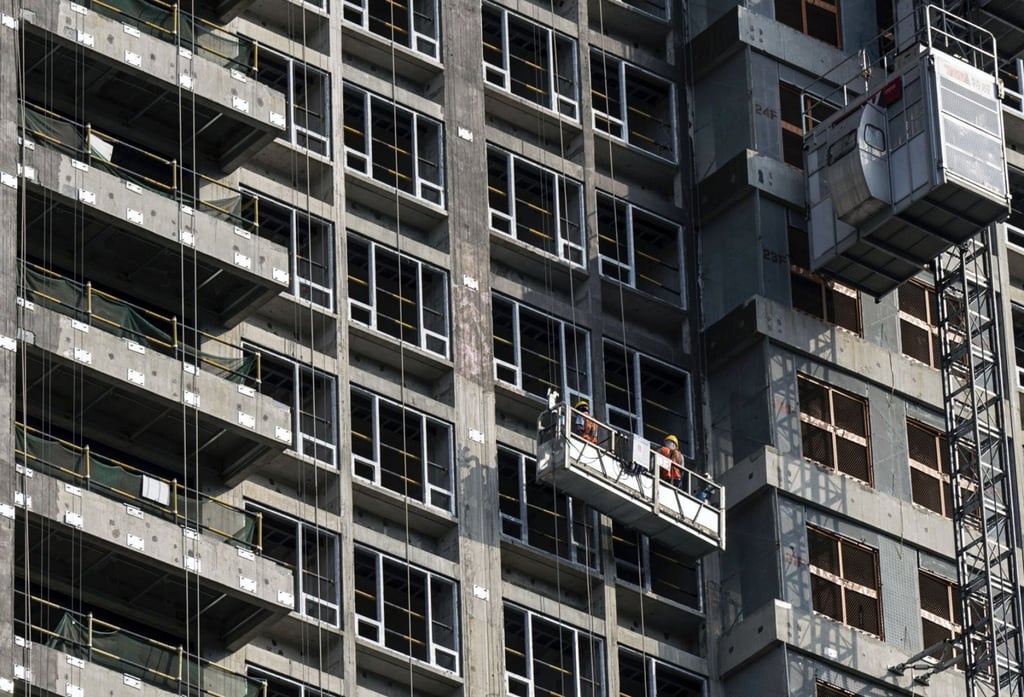
A residential building under construction at the China Vanke Co. Elegant Lifestyle project in Shenzhen, China, on Wednesday, April 17, 2024. Photo: Bloomberg
In sign of weakening consumer spending, retail sales grew by 2.3 per cent last month, the statistics bureau said on Friday, falling short of the consensus estimate for a 3.7 per cent increase. Fixed-asset investment expanded at slower-than-expected 4.2 per cent in the January-to-April period, with declines in property investment deepening. Industrial output remained as a bright spot, rising at faster-than-estimated 6.7 per cent in April.
Advertisement
Select Voice
Select Speed
1.00x