Advertisement
IPO
BusinessChina Business

China vital to Insilico’s plan to build biotech’s AI ‘Einstein’ for drug discovery

US firm, backed by Fosun and Tencent, expands research base in China as it develops an AI-powered drug-discovery tool

Reading Time:3 minutes
Why you can trust SCMP
Insilico is training and testing an AI-powered drug-discovery tool to enable faster, cheaper and more successful drug discovery. Photo: Handout
Julie Zhang
Biotech firm Insilico Medicine, backed by the Hong Kong Investment Corporation (HKIC), is building a “digital Einstein” to revolutionise how scientists discover new medicines, and plans to continue expanding its research base in China to stay ahead of global rivals after its Hong Kong listing on Tuesday.

“Biotechnology is a high-risk field like a ‘molecular casino’,” said founder Alex Zhavoronkov. “Even with artificial intelligence, you can lose 90 per cent of the time.”

The 11-year-old company was training and testing an AI-powered drug-discovery tool, Pharma.AI, to “enable faster, cheaper and more successful drug discovery with higher novelty and confidence”, he said. Zhavoronkov likened it to an “Einstein” capable of mastering fields from mathematics and physics to chemistry, biology and writing, pushing drug discovery to “new frontiers”.

Advertisement
He expected Insilico to begin opening some of its AI capabilities within the next three to five years, allowing other AI or pharmaceutical firms to speed up their own discoveries, likely through subscriptions costing about US$20 a month.

The company’s proprietary generative AI platform could read and interpret genomics and other biological data to create new drug molecule structures from scratch, instead of screening existing chemical libraries, according to Zhavoronkov.
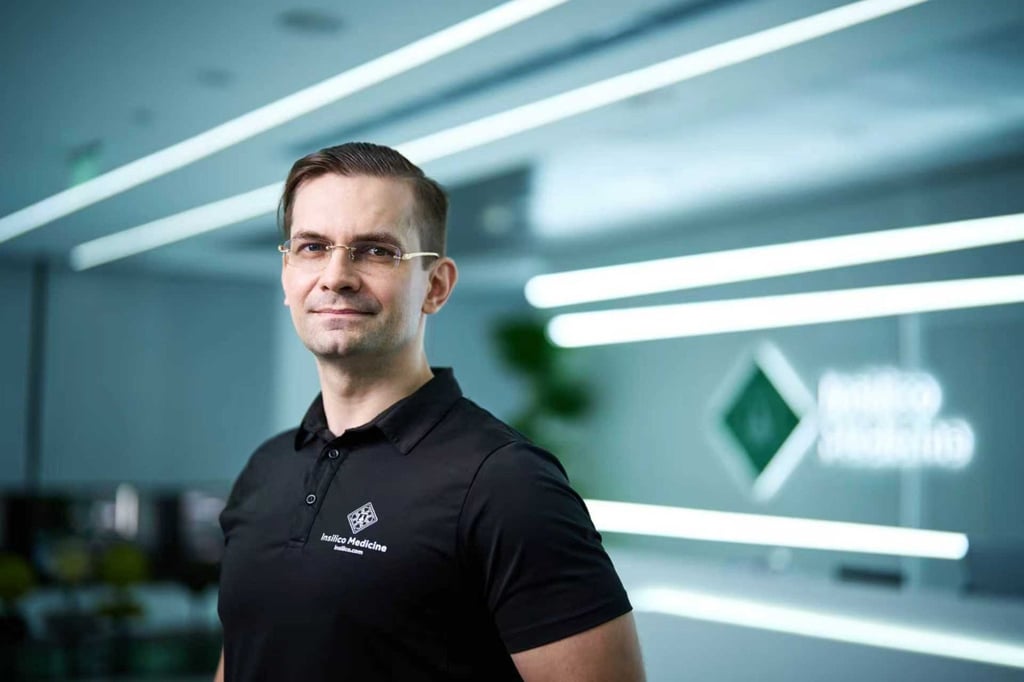
Insilico’s AI platform can read and interpret genomics to create new drug molecule structures from scratch, instead of screening existing chemical libraries, says Alex Zhavoronkov. Photo: Handout
Most of Insilico’s revenue comes from licensing drug candidates, with the remainder generated from selling AI software. It reported a net loss of US$19.22 billion in the first six months of this year, compared with a net profit of US$8 billion in the same period last year, according to its filing with the Hong Kong stock exchange.
Advertisement
Select Voice
Choose your listening speed
Get through articles 2x faster
1.25x
250 WPM
Slow
Average
Fast
1.25x