Advertisement
BusinessCompanies

New | Maersk ends mega-ship building era with new acquisition plans

Reading Time:2 minutes
Why you can trust SCMP
Michael Pram Rasmussen, chairman of A.P. Moeller-Maersk A/S, pauses during a news conference in Copenhagen, Denmark, Photo: Blloomberg
Bloomberg

The owner of the world’s largest container shipping line will stop ordering newly built vessels and instead pursue takeovers in an industry that has been plagued by overcapacity for almost a decade.

A.P. Moeller-Maersk A/S, whose Maersk Line unit has repeatedly broken the world records it has regularly set in mega container ships developed with Asian ship yards, “is done with ordering new steel,” Michael Pram Rasmussen told Bloomberg at the the company’s Copenhagen headquarters.

“If Maersk Line needs to grow, it doesn’t make sense to order new ships as there are already too many ships in the market,” Rasmussen said. “So if we want to grow, we need to do it through acquisitions so that we don’t flood the market with more ships.”
Advertisement
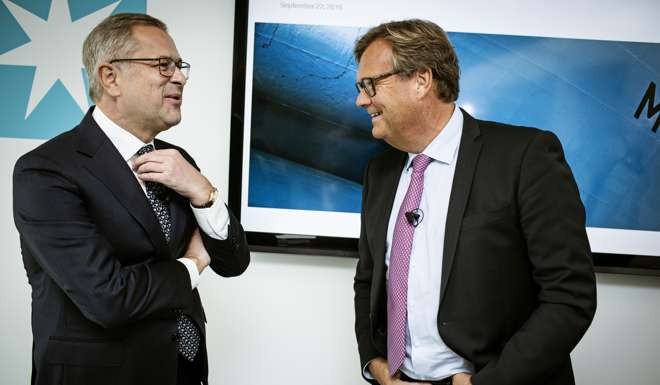
Michael Pram Rasmussen, chairman of A.P. Moeller-Maersk A/S, right, and Soren Skou, chief executive officer of A.P. Moeller-Maersk A/S, speak during a news conference. Maersk will split into separate transport and energy businesses as Denmark’s biggest company moves ahead with an historic shake-up of the conglomerate. Photographer: Bloomberg

Maersk Line still has 27 ships in its order book, corresponding to about 12 per cent of its current fleet. The container industry’s combined order book represents about 17 per cent of the global fleet.

Advertisement

Meanwhile, the shipping industry is suffering from falling freight rates caused by a combination of overcapacity and a slowdown in global trade growth.

Advertisement
Select Voice
Choose your listening speed
Get through articles 2x faster
1.25x
250 WPM
Slow
Average
Fast
1.25x